Wednesday, October 19, 2005

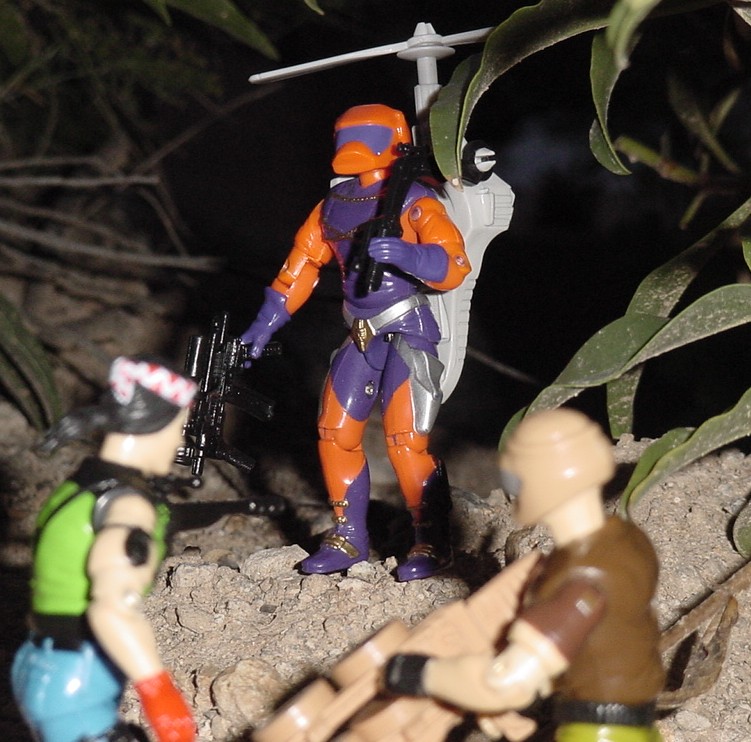
1994 Techno Viper - Star Brigade

1987 was not the greatest year for Cobra in terms of figure releases. It offered collectors some of the worst Cobra characters ever created. The few high quality sculpts that were available were the almost exclusive domain of the vehicles. One of just two bright spots in the regular carded series figures was the Techno Viper. He brought a much needed specialty to Cobra though his mold suffered from some poor design choices. The figure faded into the Cobra hierarchy and was pretty much forgotten until 1994 when Hasbro dusted the mold off and threw it into one of the last G.I. Joe retail toy offerings of the original run. The result is one of the rarest figures in the entire line. It's just that no one really knows it.

The Techno Viper mold has never quite done it for me. While it is decent, the head has never been able to hold my attention. As such, I never really went out of my way to pick up spare Techno Vipers. I acquired them here and there as I built my collection of '87 figures, but never considered them to be an essential part of any figure lot that I was considering. The mold just seemed too...plain. It lacked the trappings I would expect to find on a field engineer and mechanic. While I like for some figures to have fewer details, I also think those figures should have specialties that dictate the design of their molds. The same holds true on the opposite side as I think that specialties like the Techno Viper should have more on their molds that suggests their role in the Cobra organization.

Now, the Techno Viper is simply a bit player in my collection. On rare occasion, I may pull one out and have in part of a convoy, but they rarely are the primary focus of any endeavor. I find them useful to have, but then never use them. It is an interesting paradox as I would not consider my collection complete without the Techno Viper but I still never find any great use for the figures. They just fit too far into the background of Cobra. Now, my Cobra is heavily geared towards fast, mobile strike forces. The Techno Vipers don't play a major role in the actual combat. It is when the equipment returns to the base that the Techno Vipers get involved. As this isn't exactly an exciting part of a story, it is something that rarely gets played out.

This version of the Techno Viper was only released with the Cobra Power Fighter at the very end of the Star Brigade line in 1994. It made a very brief appearance at retail and disappeared from there. Rumours put the total production numbers of the Power Fighters at around 10,000 units. However, as there are only supposed to be 10,000 of the Lunartix aliens and those are MUCH more common than this Techno Viper or the Gears figure who piloted the Joe Power Fighter, I would say that the production run for the Techno Viper is probably overstated. You just don't see Power Fighters or Techno Viper figures in numbers similar to other late run items who were underproduced.

The Techno Viper was only ever released by Hasbro. It never appeared in any of the other countries who produced their own Joes. As Hasbro was able to resurrect the Barricade mold that was used for Gears in 1994, it is possible that the Techno Viper mold is still available for production. It is a figure that would benefit from a re-release as it is relatively popular and a different color could energize collectors to purchase them in multiples. The downside, though, is that even mint and complete, V1 Techno Vipers are very easy to find and cheap to acquire. So, many army builders already have large armies of Techno Vipers and might be hesitant to double or triple their already burgeoning numbers with the same figure in only a slightly different paint scheme.

The nice thing about the 1994 version of the Techno Viper is that his unique coloring allows him to stand apart from the rank and file Techno Vipers yet still fit in with them. His purple perfectly matches the darker purple parts of the '87 figure but the copper tunic makes him appear as a Techno Viper commander or some other advanced version of the basic trooper. That's good since his scarcity means that most collectors will have a much more difficult time tracking down multiple '94 Techno Vipers than they will '87's.

Some collectors don't like the purple colorings of the Techno Vipers in general. For me, I've always seen purple as key Cobra color. While basic blue usually denoted combat troops, purple denotes specialty and technical troopers. Entities like the Toxo Viper and Techno Viper use purple to show they are more specialized and not the type of troops who are involved in front line combat. So, I don't mind the coloring as much.

My first encounter with the Techno Viper mold was in 1987. On a late spring Saturday, my parents took me to Toys R Us. As it was lawn mowing season, I had a bit of money to spend on new Joe toys. I found an Outback, Fast Draw, Law & Order and the Road Toad. My younger brother chose the Techno Viper. When we got home, I took all our new toys out into the yard and spend the afternoon and early evening having Cobra attack my new Joe convoy. After dinner, I moved the play inside. I sat in the family room of my parents house with the windows wide open: enjoying the sounds of spring insects and the smells of fresh plants as I played and played. The evening ended when Saturday Night's Main Event came on around midnight. For some reason, the pure innocence of that night has come to embody the essence of my childhood and has left an impression that I will never forget. Whenever someone asks me why I still collect Joes, this is the real reason. But, finding a way to properly convey that to any inquisitor is usually a lost cause.

To be frank, this version of the Techno Viper is nearly impossible to find. Every now and then you can find some boxed Power Fighters that some dealer stashed away in the mid '90's. But, even those are tough to track down. However, this has not made the Techno Viper as expensive a figure as his rarity would suggest. You can still acquire the figure for around $20 or so if you are patient. Since this figure is pretty much under the collector radar you can still find them for fair prices. At this point, those collectors who know about this figure have acquired one. Most of the others, though, don't really care. It is the laissez-faire attitude towards this figure that has kept him from reaching the $40-$60 price point that would easily be justified were this figure a little more eye-catching. As always with figures like this, though, the time to act if you want one is now. Truly rare figures are tough to come by in the American Joe line. Eventually, the marketplace finds them and prices them accordingly. That hasn't happened to this version of the Techno Viper...yet. At some point, though, one will go for a king's ransom on Ebay and this figure will enjoy a few months as the toast of the Joe collecting world as collectors scramble to add him to their collections. I've found it's always better to be ahead of that curve. It's just anticipating which figures will be the next to go crazy that is the hard part.

1994 Star Brigade Techno Viper, 1984 Wild Weasel, Ratterl, 1986 Strato Viper, 1986 AVAC


1994 Star Brigade Techno Viper, 1987 Techno Viper, 2004 Unproduced Urban Assault Firefly, Midnight Chinese, 1995 Iron Panther Tank, Sgt. Savage

1994 Star Brigade Techno Viper, 1987 Techno Viper, 1994 Star Brigade Cobra Commander, 1994 Detonator, 1995 Iron Panther Tank, Sgt. Savage

1994 Star Brigade Techno Viper, 1987 Techno Viper, 1994 Star Brigade Cobra Commander, 1994 Detonator, 2005 Convention Iron Grenadier Destro, 1997 Stormshadow, 1994 Metal Head

Wednesday, October 12, 2005

1989 Annihilator - Redux

I originally profiled the Annihilator in December of 1999. In the nearly 6 years since I wrote that profile, little about my interest in the Annihilator has changed. I still consider him a great forgotten army builder from a year that is already full of great army builders. My re-examination of the figure stems from the fact that as one of my earliest profiles, my take on the Annihilator was not "finished". It felt lacking as the profile had no depth and did not fully cover the usefulness of this figure. Plus, the Annihilator's role in my collection has expanded as my Cobra now focuses its operations in manners that suit the Annihilator.

The Annihilator is a very well done figure. His mold is sleek and streamlined: just as needed for a trooper whose primary duty is operating an individual helicopter pack. His accessories are amazing with the fully detailed and spinning chopper as well as one of the most distinctive guns in the original run of the line. He suffers, though, from poor color choices. The orange and purple simply don't allow this figure to be as popular as the mold and accessories would suggest. The side benefit to this, though, is that the figure is cheaper than many of his contemporary Cobra army builders. 1989 is generally considered one of the best years for Cobra army builders in the history of the line. It is so good that most people would not consider a figure like the Annihilator (who would be the class of several other figure years) to be even in the top 5 army builders released in his own year. That helps to further denigrate this figure and pushes him lower on the popularity scale than he probably deserves.

In my collection, Annihilators are not Destro's troops. They are a highly specialized branch of my Cobra Urban Death Squads. My Cobra learned a few years ago that the best way to terrorize the citizens of various countries was to show them how tenous their civil safety really was. To accomplish this, Cobra targeted several small but densely populated but still rural towns and cities. In a matter of minutes, Cobra dispatched highly trained Alley Vipers to basically run over a small geographical portion of the town: killing everyone and everything they came across. The raids simply underscored how easy it was for a terrorist organization to strike at anyone in the country at any time. No one was safe: not even in the small, almost off the map towns that have reputations as havens from urban crime.

The Urban Death Squads who carried out these macabre orders are comprised of highly trained Alley Vipers. They are trained to shoot first and kill everything. In order to cut down on their friendly fire fatalities, though, Cobra outfitted the brigades in bright orange. While this may seem like it would make them easy targets, the reality is that these troops descend quickly upon towns with small, undertrained and underarmed police forces and no military presence. So, they have little to worry about in terms of opposition soldiers shooting at their orange visages. Instead, they know that anything they see moving that is dressed in orange is one of them and they can sedate their killing tendencies for that one instance. It helped reduce friendly fire deaths but also allowed me a way to explain away the V1 Alley Viper's orange color.

The Annihilators came into play after the third Urban Death Squad attack. During that attack, the Joes had a covert operative in the town. As the Death Squad descended, the operative managed to signal a Tomahawk to come rescue him. The Alley Vipers watched in vain as the chopped picked up the operative and carried him to safety. (Actually, the chopper was hijacked on the roof as it picked up the operative but that's a story for another profile!) This lead to the first surviving witness to a Death Squad attack. Cobra could not afford that and they invented the Annihilators as means to patrol the skies and prevent any more helicopter rescues. While keeping opposing choppers away is part of the Annihilator duties, they are also the first line of offense in a Death Squad attack. When Alley Vipers burst out of their hiding places and come running through the town, the Annihilators appear over the horizon and start landing much as is described in their filecards. They are simply an extension of the Alley Vipers. While some stay airborne the entire time to act as spotters or to mop up any survivors who try to run through the attack line, Annihilators, typically, land on the rooftops of larger buildings to work their way down through the top floors to meet with the Alley Vipers coming through the bottom at some point in the middle. They also land in the center of the attack area and fan their way out to also meet up with the Alley Vipers who are closing in from the outside. It makes the attacks much more efficient and allows them to finish much more quickly. The hallmark of an Urban Death Squad attack is that it is over, everyone in the area who isn't a Cobra is dead and any Cobra fatalities or injuries are cleaned up in under 15 minutes. That way, by the time authorities arrive, there is simply no evidence of who perpetrated the attack but there is a devastating amount of civilian death and destruction left behind.

As the concept of the Urban Death Squad is rather prominent in my Joe world, the Annihilators get used rather frequently. As my Death Squads have matured, they have begun to take on military installations and some Annihilators now fight against real armed foes rather than panicked, unarmed civilians. Here, they don't fare as well. But, the experience learned from the civilian attacks has given Cobra a much more experienced army: especially in South America. As my Cobra looks to expand its operations into Africa, I can see the Annihilators remaining an important part of Cobra's military strategy. The personalized choppers give Cobra a mighty force with the portability to retain the element of surprise against their quarry and a reliable means of extraction if something goes wrong. That is a good combination for them to have as it meshes with their planned style of guerrilla warfare.

After its use in the US, the Annihilator mold was sent to Brazil. There he was released with slight color variances and different accessories. The figure has not been seen since. The Brazilian Forca Electronica series of which the Annihilator was a part also included molds from the '89 HEAT Viper, '88 Muskrat, '87 Outback, '89 Frag Viper, '88 Toxo Viper, '88 Repeater and the '89 Scoop. These don't offer many useful clues as to the status of the Annihilator mold as 2 of the figure molds have been subsequently used in the US, 2 were used in India and the other three have yet to appear anywhere else. So, it's difficult to say whether or not this figure is available. The fact that he was not repainted as part of the 2005 Iron Grenadier themed convention set, though, leads me to believe that the Annihilator mold is gone and this is a figure forever doomed to his orange legacy.

Personally, I would like to see a repaint of the Annihilator. This is a mold that could be painted in a multitude of ways and all would be more useful than the original. The figure could be painted Cobra blue and integrated into Cobra or offered in black and gold as part of the Iron Grenadiers. Either way would work. Unfortunately, as we have yet to see this happen, I doubt it will ever come to pass. Even so, I don't mind that as much as it allows the Annihilator to remain one of the undiscovered gems of the vintage line. I think that some figure molds should be left alone and never repainted. Usually, though, those are only figures that were done right the first time. As the Annihilator was flawed in his original incarnation, though, he would be a perfect candidate for repaint and a figure I would have considered long before many of the repainted molds we have actually received.

Annihilators are actually rather easy to find. Mint versions can be tougher since he the gold paint on the chest does tend to fade easily. However, even a figure with slight paint rubs is still very useful in a collection and makes for a great army. Even complete, you can easily acquire Annihilators for around $10 each. If you want them with less than their full complement of accessories, you can get them even cheaper than that. The fact that this figure is not, technically, a Cobra and the multitude of other 1989 Cobras who outshine the Annihilator help keep him lower in price. He remains a vintage army builder with a great mold and awesome accessories that is still affordable. While his color might scare some away from spending too much time acquiring the figures: I have found it to be an integral part of his specialty. I doubt my use of the figure will change the perception at large in the collecting world about this figure. But, if he gets even just a little more respect, it's worth it to me.

1989 Annhilator, Iron Grenadier, Destro, 1988, 1992 Spirit, 1990 Salvo

1989 Annhilator, Iron Grenadier, Destro, 1988, 1992 Spirit, 1990 Salvo

Wednesday, October 5, 2005

2003 Crimson Guard Immortal

There has always been just one word that I've used to describe the Crimson Guard Immortal mold: mighty. It seems the only fitting adjective for a mold that radiates power not only in character of the man wearing the uniform but also the might of the weapons associated with it. I have long been fascinated by this mold and spend a lot of time in the late '90's trying to acquire many of them. Back then, though, it was rather difficult to find complete CGI's. But, in 2001, Funskool came through and released a very nicely done version that was made available to American collectors for cheap prices. Sometime in early 2003, though, Hasbro re-acquired this mold from Funskool and threw it into a craptacular KB Toys exclusive vehicle. The new color scheme didn't make much sense considering this is a CRIMSON Guard, but the result was a figure that is actually very nice and worth owning.

The CGI mold remains my favorite appearance for any Crimson Guard. The armour plating, cool helmet and overall combat feel of the mold make one that just exudes power and might. The mold is intricately detailed with ammo pouches, knives and clips holding the armour in place that show an attention to design that was advanced even for the vintage Joe line. It is a shame that the most common version of the mold is actually the version that was intended to only be released in India. Armies of CGI's of any color look good, but are hard to find. Few collectors who have been able to amass large quantities of non-Funskool versions of this mold take the time to display them.

When I first got this figure, I didn't have much in the way of a story for him. At the time, he was just another figure I needed to complete my collection. However, as I looked at him, I wondered what I could do with him that would explain his odd uniform color. As I mentioned in my Cobra Commander profile, I don't think highly of the Crimson Guard concept any more. Mostly, they are corpulent slugs who have degraded into a disease festering on Cobra Island. However, even the most corrupt and vapid organizations have bright spots. Surely there would be a few decent members of the CG left. Shortly after I acquired this figure, I began to map out the plans for the next story arc in my Joe world. Cobra had spent the past decade in South America and was wrapping up their operations there. The next target had been selected and my South American commander, Ramen, was beginning his exploration of Africa.   Lead by Skeres, Operation Dark Cloud is Cobra's push into Africa. Their motives there are unclear to all but Ramen and his cabal, but their success in South America has given them the freedom to retain that type of secrecy. Skeres leads the 1st Afrikaaner Division in Africa. They are a cadre of Cobra's most battle hardened troops: most of whom earned their wares in South America. They are a close knit group who are skeptical of anyone who has yet to prove himself. But, are fiercly loyal once someone is welcomed into their group. They believe whole-heartedly in the Cobra cause and are willing to sacrifice their lives for the fulfillment of the aims of Ramen's Cobra.

This all leads to the origin of this figure. I use this figure as a man who was a newly appointed CG. As part of the initiation in the Crimson Guard, new recruits are left as Crimson Guard Immortals. Basically, this means they are still on combat duty and are often assigned to head up combat operations at small Cobra installations. It is a way for the new recruits to grow into their responsibilities as well as mature within the nepotistic system of the CG's that rewards politicking more than it does valor. This CGI was appointed to guard a remote Cobra research installation in South America. It was a mundane duty that became suddenly dangerous when a group of American commandos stormed the compound. The CGI had orders from the Crimson Guard hierarchy to save himself in the event of an attack, but his sense of duty lead him to personally fend off the attackers while the Toxo-Vipers in his charge successfully destroyed all evidence of their facilities' purpose and then escaped to a just arriving Cobra transport chopper. As the pilot prepared to take off, the head Toxo Viper ordered him to wait for the CGI. The CGI managed to escape, carrying the limp body of the lone Toxo-Viper who had been left behind.

These heroic actions caught the attention of both Skeres and Ramen. They invited the CGI to the South American headquarters and asked him if he was interested in joining with the Afrikaaners. The CGI tentatively accepted and then returned to Cobra Island. Here, he was accosted by the Crimson Guard hierarchy and pressured to join the Afrikaaners as a spy for the Crimson Guard. The CG were leery of Ramen's success since they were not part of any of it and they looked at this opportunity as a way to finally infiltrate Ramen's most trusted circle. The CGI agreed and promptly left Cobra Island to return to South America. Shortly thereafter, Afrikaaners had a confrontation with some Crimson Guards in a Cobra cafeteria. It escalated to a point where the CG's felt it was time to announce their plant within the Afrikaaner forces. When they called for this CGI to appear before them and Skeres, he came as requested. Only, instead of wearing the crimson uniform of his unit, he had changed his uniform color to this grey-blue as a symbolic break from his Crimson Guard past.  Disgusted that members of his organization were more concerned with political power than overall organizational success, he then fully joined the Afrikaaners and is now a trusted high ranking member of Ramen's most effective combat unit. (Shortly thereafter, the Crimson Guard Rebellion took place on Cobra Island. It is thought that the defection of this CGI was one of the last straws in the Commander's lack of patience with the CG's.)

As is the case with most figures for whom I have developed an intricate backstory, this figure is now an integral part of my collection. He is almost a named Cobra, but not quite. It is my expectation that at some point, he will become a named Cobra, but he is still learning and it will be a while before he sees another promotion. (Plus, I have to find a new figure to represent him. I have pretty much exhausted all the available Cobra molds from around the world that could be used as unique characters. Hopefully, Hasbro will put out a figure or two at some point that will be useful in this capacity.)

The CGI mold has a well traveled history. He was released by Hasbro in 1991. He was not carried over to 1992, though. He was released in Europe almost simultaneously, but a few of the European figures were released with the V1 Rock Viper's head in lieu of the CGI head. From there, the mold may have gone to Brazil where it was intended to be released as Flagelo. It is unlikely, though, that this figure ever saw production beyond the artwork in Brazilian catalogs and cardbacks. However, in 1993, Hasbro resurrected the head for use on the hot pink Create a Cobra mail away figure. In 2001, the mold appeared in India where Funskool used it for about 18 months before Hasbro re-acquired it. It was used by Hasbro for this figure in 2003 and then again for the convention exclusive Destro body in 2005. Most notable, though, is the mold's absence in the Operation Crimson Sabotage set, the Crimson Guard 6 pack Toys R Us exclusive set and the Crimson Shadow Guard. Hasbro passed by three prime opportunities to use the mold again. With the overall number of ARAH releases dwindling and the fact that the mold was used in a convention set, I would say that it is highly unlikely we will see this mold used in any sort of army building set in the near future. That is unfortunate as this mold isn't as stale as some of those that will certainly be used but also nice in the sense that the mold won't get overused like the Cobra Trooper, Cobra Officer and newly sculpted Crimson Guard molds have.

This figure's availability was annoying at best. First off, the Crimson MOBAT was made a KB exclusive. This alone would have made it tough to find. However, KB ended up only offering this vehicle on their website. As such, it became a de facto online exclusive. This made it very expensive to acquire as the Crimson MOBAT was $20 and very expensive to ship. This deadly combination resulted in the tanks sitting on KB's website for some time. Finally, in 2004, KB began to clearance the tanks. First, they went down to $15. Then $10. Finally, they sold out at an $8 price tag. For that price, many dealers and collectors were buying them, tossing the tank and just selling or keeping the figures. The result is that this figure is now more widely available for decent prices than many might have originally anticipated. It doesn't hurt that many collectors have also done as I have and use these figures either as individuals or highly specialized army builders so they don't require more than 1 or 2 examples in their collection.

Now, you can usually get this figure for around $10 or so. Frankly, that isn't a bad price considering that Hasbro has now produced 3 subsequent Crimson themed sets and this mold has not appeared in any of them. The CGI mold is very high quality and would be hard to produce in a bad color scheme. This silverish blue version is a great way to use the mold outside of the ranks of the Crimson Guard and offers some diversity that most of the other Crimson themed molds have always lacked. I enjoy this figure for what he is and for what I have made him in my collection. It seems that many other collectors do, too.

2003 Crimson Guard Immortal, KB Toys Exclusive, 2005 Night Watch Trooper, 2003 Convention Exclusive Air Viper

2003 Crimson Guard Immortal, KB Toys Exclusive, Skeres, Cobra Trooper, Officer, 2004 TRU Exclusive

2003 Crimson Guard Immortal, KB Toys Exclusive, Skeres, Abutre Negro, Brazil, Estrela, Patrulha do Ar, Black Vulture, 1991, Tomax and Xamot

2003 Crimson Guard Immortal, KB Toys Exclusive, Cobra Trooper, 1983, Lt. Clay Moore, 2007 Convention Exclusive, Viper, Iron Panther, Sgt. Savage

Thursday, September 29, 2005

Muralha - Brazilian Exclusive Flint

Flint has long been one of my favorite Joe characters. Over the years, I've profiled many versions of him but still consider the original mold and paint scheme to be my favorite. As I examined that figure twice on my original site, it was difficult to come up with a way to re-evaluate the character without going back and re-doing something I had already done. Instead of doing that, though, I found a different way. And, in the process, found a new version of Flint that is just different enough from the American version to be interesting. I present Muralha: the Brazilian version of Flint.

To me, Flint is the consummate Joe figure. The main reason is that while his look is grounded in military design, he also features elements that give him personality. The cocky beret, short sleeves with gloves and shotgun shells on his chest give Flint a look that makes him iconic in the Joe line. Flint shows a thoughtfulness in design that transcends his own remarkable release year and makes him one of the most recognizable figures in the history of the line. He is what made the Joe line enduring. You can look at Flint and see he is a military toy. However, you can also look at him and see a character that is not just a nameless soldier. It is this combination of realism suggesting fantasy that made the vintage Joe line successful while its imitators fizzled away.

In my collection, Flint is still one of the most important characters. Regardless of which version I choose to use, Flint is almost always one of the leaders on any significant mission. He is a field commander who holds the respect of his men but also a cunning warrior who is probably the most dangerous man in any combat situation. That idea is what makes Flint so interesting to me. I see Flint as someone who is incredibly talented and whose actions appear to border on recklessness. However, he fully knows what he is capable of achieving and does not take unnecessary risks. I have this as an element that has held back Flint's career since some view him as arrogant and full of himself. More savvy battlefield officers, though, would take Flint as their first choice when choosing a combat unit. This leaves Flint with a cadre of hardened fighters on his side while the more cautious, politically inclined officers tend to view him as a liability. This creates internal conflict in Flint as he always viewed his military career as a stepping stone to greatness. Now, he finds his advancement blocked by those whose careers he has elevated due to his service under their command. It is a hard lesson and one that slowly embitters Flint as he continues to risk his life out of a sense of duty yet knowing that he will most likely never be able to achieve his ultimate goals for the very same reason.

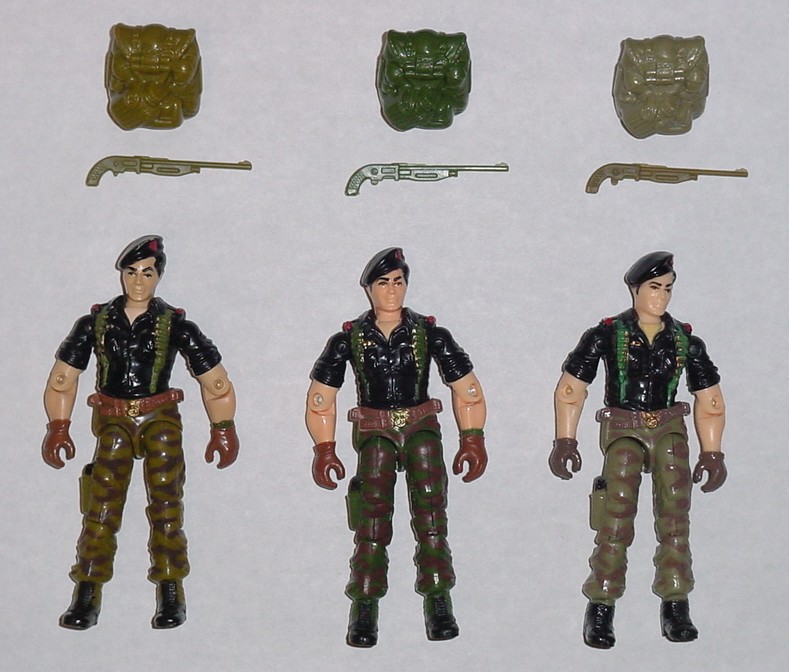
Muralha is actually of very high quality. It seems that Brazilian figures grew more brittle as the line went on. Muralha feels like an American figure and would be nearly indistinguishable from most American figures of his time. If you really know what you're looking for, though, you can feel that the plastic is a slightly more brittle than the American figure. Muralha's colors are obviously meant to mimic the American figure. The green on his legs, though, is actually a shade darker than the American Flint and gives the figure a more muted appearance. It is a subtle difference and not on you would notice if you did not have an American figure against which to compare it. Muralha's accessories are the same as Flint's. They are a darker green as well, though. Muralha's accessories are pretty much the same color as the Tiger Force Recondo's backback. These would actually stand out were a collector to aquire them unknowingly. The final picture at the end of this profile shows the 3 main versions of Flint: the American Flint, Muralha and the Funskool Flint. Side by side you can see the subtle color differences in the figures and the accessories and gain a greater appreciation for the nuances in each country's release.

Muralha, Brazil, Flint, Estrela, Funskool, 1985


Personally, I'm not done with this Flint mold. While it may seem overused to an extent, the reality is that this version of Flint has really only appeared in 3 basic color schemes: the original with it's slight variations, Tiger Force and Night Force. All three of those paint jobs lend themselves to the same type of environments as well. As such, I would be happy to see Flint re-appear in a desert or arctic theme. His mold is such that it could be adapted for those types of paint applications without a major overhaul. Plus, the figure mold is one that collectors still enjoy. Unlike Duke, Stalker or Snake Eyes, Flint has yet to be overdone to the point where collectors are sick of him. The fact that he's a major character only furthers my case.

The Flint mold has had a long history. It was first used in the US in 1985 and then again in 1986. After that, the figure was repainted in Tiger Force colors in 1988. At this time, the date stamp on the figure was changed from 1985 to 1988. Around late 1988 or early 1989 Flint began to appear on the backs of Argentine figures made by Plastirama. However, he was never actually released as Plastirama ceased operations around that time. In either 1989 or 1990, Muralha was released in Brazil. This figure features the 1988 date stamp as well. Sometime in the mid 1990's, the Flint mold then made it's way to India where it was released by Funskool. In India, though, the figure was never released with the original Flint forearms. Those appear to have gotten lost or damaged at some point between the use by Estrela and the mold's arrival in India. As was common practice for them at the time, Funskool blurred out the date stamp on Flint's legs. You can still see a faint mark of the 1988 date stamp, though. In April of 2003, Flint was returned to Hasbro and the mold was used in the 2004 Night Force set. This mold, though, featured a prominent 1988 date stamp on the figure's leg. This is significant since the Night Force Beach Head figure that was in the same set also featured a mold returned to Hasbro by Funskool in April of 2003. The Beach Head mold featured a rubbed out date stamp but the Night Force Beach Head featured a prominent 2003 date stamp.   So, the question is why did Hasbro update the date stamp on the Beach Head but not on Flint? While we will probably never know for sure one of the more probable explanations is that there was an additional mold for Flint's legs that had remained under Hasbro's control since 1988. Flint was a very popular figure and character so it is possible that his original figure was created from multiple molds. Regardless, though, it shows the subtle changes that can occur in molds as they move across continents over the decades.

Time was, figures like Muralha were almost impossible to find. The Brazilian postal service is not the most reliable resource in the world and trading with Brazilian collectors always posed a unique challenge. While Brazilian figures were desirable, the inherent risk in sending high value packages to and from Brazil made many collectors nervous. One lost package was enough to stifle a collection for a long time. Those who wanted Brazilian figures, though, had few other options. Those American collectors who did have multiples of the Brazilian figs usually wanted a great deal in exchange for them. As such, collectors were often shut out of the figures like Muralha as they didn't feel the figure justified a $40 price tag but could rarely find it for less without incurring the risk of trading to Brazil. Now, though, that has changed a bit. Finally, the Joe collecting world has become big enough to support a dealer network that is capable of bringing figures like Muralha to American collectors for decent prices. I highly recommend checking out online dealers for figures such as these as they have been one of the first reliable dealers to continually stock the lesser known Brazilian figure variants. I feel every collector owes to themselves to have at least one or two foreign figures in their collection. If only as a conversation piece. Foreign figs add depth to a collection and give it a bit more personality. Time was, they were going to cost you. Now, though, a small investment will bring some foreign figures to your collection. I feel it is one of the most worthwhile purchases you can make.

Muralha, Brazil, Flint, Estrela, 1985, Snake Eyes V2, Footloose, 2001 Desert Striker

Muralha, Brazil, Flint, Estrela, 1985, Snake Eyes V2, Footloose, Eel

Muralha, Brazil, Flint, Estrela, Plastirama, Argentina, Coyote, Condor, Fuego, Risco, Alpine, Footloose, Airborne, Ripcord, 1986 Tomahawk

Muralha, Brazil, Flint, Estrela, Plastirama, Argentina, Coyote, Condor, Fuego, Risco, Alpine, Footloose, Airborne, Ripcord, 1986 Tomahawk


Wednesday, August 31, 2005

1993 Battle Corps Law

In the history of the Joe line, Hasbro really produced some clunkers. While the line if chock full of some amazing figures, you can also find some examples that are just really, really bad. In some cases, the mold was just poorly sculpted. In other cases, the colors were horrendous. As the line progressed, some were just poor molds for the characters that they were chosen to represent. The subject of this profile, the 1993 Law, was a combination of the last two. This is a poor mold choice that has little to remind you of the classic character and it was poorly colored. However, he does still have some potential uses as I will outline below. My first encounter with this figure was when I found him hanging on a neglected clearance shelf at the Bloomington, Indiana K-Mart during Christmas break in 1995. At that time, I picked up any Joe figure I did not have, so I added this Law to my collection. However, I was stymied as to his purpose in my collection.

Even back then, I had multiple versions of V1 Law and used that figure as an army builder. The Law character was not someone who had ever really been developed in my Joe world and this figure just didn't lend himself to an important, named character. As such, I packed the figure away into a plastic bin where he would emerge every now and then in various meaningless capacities. One day, though, I put him on the crew of my Shark 9000. When I did this, I finally found a purpose for this figure.

Now, in my collection, 1993 Law's are nameless, faceless maritime vehicle operators and gunners. They are also full fledged combat divers, but only perform that duty in times of extreme duress. (Other figures like the '93 Payload and '94 Shipwreck better fill the full time role of combat diver.) Mostly, these figures can be found manning the guns on the Shark 9000 or even the Whale. They might be the helmsman on the Tiger Moray. Most times, though, they can be found as the sole pilots of the Devilfish. This figures colors actually kind of work with the bright orange Devilfish and I think the figure looks decent as its captain. (If you have the blue Devilfish from India, this figure matches it even better.) It's very much a bit role, but this isn't the type of figure who demands to be a major player in a collection. As such, I think that he works well in this capacity.

As was proven by the Shock Viper, Joe molds can be converted to successful Cobra army builders. One look at this mold and you could easily see how this figure colored in Cobra blue and dark grey and outfitted with air tanks, some flippers and a spear gun could easily be turned into a new version of the Cobra Eel. I think that would be the type of thing that would earn Hasbro raves as it would produce a cool figure of a character that needs to return in ARAH format as well as offer collectors something new and original. Hopefully, if we will get the opportunity to see something like this down the road. Hasbro's non-convention ARAH figures have been bland at best for some time now. While there is little to indicate that this will change: there is always the hope that a breakout figure will appear at some point down the road.

At first glance, this figure isn't that bad. His base color is a soft grey (that perfectly matches the color or Torpedo's backpack) surrounded by deep blue trim. Had the figure stopped there, he would be very useful. As he was released in 1993, though, he would not be complete without the requisite splash of neon. So you see his chest is now covered in a bright greenish-yellow that makes it harder to find a use for the figure. The mold itself, though, isn't that bad. The head is quite detailed, even though the detail are not painted. The body is bulky (probably as his intention was as an urban combat specialist) but has some minor trappings that give him more depth than it would, with a cursory perusal, appear. His accessories are terrible as they are neon versions of bad weapon molds. He does have a neat little feature on his spring loaded launcher, though. Law included a (neon!) shield that fit over the barrel of the spring loaded weapon. The idea behind it was neat, even though the execution was poor. If Hasbro were to revisit the idea today, I think they could make a very nice weapon/shield combo that would become one of the better accessories in the line. But, as it was '93, this version is only useful for the concept.

This mold had a short history. 1993 was supposed to have its own D.E.F. subset as a carry-over from 1992. After the '92 D.E.F. bombed at retail (It really had nothing to do with the figures. It was a matter of economics. Why would a parent buy a D.E.F. figure for $5 when a similar figure in the regular series sat next to it on the shelf for $2.79? The price point was the failure: not the concept or the figures.) Hasbro canned the '93 version and just threw the '93 D.E.F. figures into the regular Battle Corps assortment. These figures sat around, too, as the Joe line died around them and were easily found at clearance stores well into 1995 and 1996. In Australia, though, the figure was released on a D.E.F. card. There was no difference in the figure: just the card. Sometime around 1995, the mold was released in Brazil as Bolidus. The colors were slightly different, but still bright. As he was one of the final Brazilian releases, it is doubtful that Hasbro has access to this mold. If Hasbro had intentions of bringing this figure back as Law: then it is a good thing that the mold is likely gone. However, if they were going to bring it back in a faction-switching role as I mentioned above: then it is our loss that it the mold is in Brazil.

If you want a 1993 Law, you won't have to look very hard or spend very much. MOC, you can get them for under $3 at times. Dealers will sell complete versions for more: mostly because they can't justify handling a figure that they can only sell for a dollar or two. If you scour Ebay, though, you can get nice versions of this figure for nothing. Collectors simply don't care about him and never will. I've found that he's useful in a collection to a point. I have a few of them that I use to man various positions on my aquatic vehicles. Beyond that, though, his use is limited and I have little desire to add any more to my collection unless I get them for a ridiculously cheap price. Most collectors feel the same way and this figure is likely to forever remain one of the more obscure releases in Joe history.

1993 Battle Corps Law, DEF

1993 Battle Corps Law, DEF

1993 Battle Corps Law, DEF, 1985 Lamprey