Saturday, September 12, 2020

1997 Stalker - Random Photos Of The Day

The 1997 Stalker figure is probably the best 1997 repaint.  And, he's one of the best repaints of the entire 1997-2006 era.  The deeper green color, more complex cammo pattern and additional paint applications all add up to a figure that's better than the original.  There was a lot of consternation over his black beret back in the 1990's.  But, really, it looks better with the rest of the figure than a green beret would.  The softer plastic also means this guy's thumbs, crotch and heels won't snap if you touch them.  This guy's now way older than 1983 Stalker's were when this 1997 figure debuted.  I still hold this figure, though, in the highest regard.  He's been profiled twice on the site and appears in dozens of photos.  He's just a figure that looks good.

1997 Stalker, GHSB, Gold Head Steel Brigade, Black Major, 2001, Tripwire, ARAHC, Rock and Roll, Red Laser Army, Sightline

1997 Stalker

Thursday, September 10, 2020

1986 Zarana - Around The Web

I was never a huge Zarana fan.  While I found a use for Zandar for a short while, Zarana never had that occur with her.  Her lack of firing weapon and general poor design left her as relatively useless for me.  My brother had the earrings head version which I thought looked like one of my aunts.  That's about the end of the pertinence Zarana had for me.  I didn't care for her being such a prominent character in the comics and would skip over the pages that featured her and Road Pig.  But, Zarana has found a large collecting audience since the 2000's and remains a popular figure.  As such, there's tons of great work that's been done with her.  Here's some of my favorite Zarana content from around the web.


1986 Zarana, Zartan's Sister, BATs, Battle Android Trooper


1986 Zarana, Zartan's sister, Dreadnok, Monkeywrench

1986 Zarana, Zartan's sister, Dreadnok, Monkeywrench

Tuesday, September 8, 2020

Cobra De Aco - Black Major Version

There was a time in the Joe world where information was scarce.  We now know that the reason for this is that many collectors like to hoard information and keep it to themselves.  This gives them "credibility" in the Joe community.  The side effect of this is that bad information can quickly take on a lift of it's own.  And, in some cases, left unchecked, the bad information is perpetuated by an "official" release.  In the case of the Brazilian Cobra De Aco, bad information lead to a perception that the figure was among the rarest in the world.  Time has proven that false.  But, the damage was done as the figure remains far pricier than many of his harder to find contemporaries.  Fortunately, the Black Major dropped a version of the De Aco about a decade ago so that every collector would have a shot at the character.

So, as I held this figure for the first time, something dawned on me.  One of the reasons that the De Aco is so out of place is because of his color scheme.  Yellow isn't, traditionally, a Cobra color.  So, he's very distinctive when viewed through the lens of early Joe releases.  However, the Cobra De Aco was likely released in 1986.  If you look at the 1986 American releases, there is a figure that is very similar to De Aco's color scheme: the 1986 BAT.  It seems an unlikely coincidence that Brazil would release a figure with a chrome head and a color scheme to match the American android in the same year as that figure's debut.  Is the De Aco based on early renditions of the BAT?  Or, was the color scheme adopted in an attempt to have a release in Brazil that matched the American BAT?

International exclusive characters remain one of the great mysteries of the Joe world.  How did exclusives like the De Aco, Manleh, or even the European Mutt come to be?  Seeing the De Aco's similarity to the BAT, though, makes me think that the foreign companies had access to either abandoned Hasbro designs or to successful color palettes that were being introduced simultaneously in the U.S.  We have gotten a lot of great stories about the origins of the American line from some of the Joe creators.  But, we have not heard much of any collaboration with foreign Joe licensees (assuming such communication even occurred).  

Harsh reality time.  The Cobra De Aco isn't a good figure.  (The Cobra Mortal isn't, either.)  Were this an American release, collectors would deride it.  Were this an American release from the 1990's, the figure would be a joke.  But, because the De Aco was an exotic oddity, a mystique built up around it.  That aura was augmented with the 30th Anniversary card set released in 1994.  Here, the De Aco made his most famous debut with the tagline that "no mint samples have been identified thus far".  This made many collectors think the figure simply didn't exist.  But, the explosion of the internet proved that wrong.  By 1998, it was well known that the De Aco was very obtainable from Brazil and that another figure featuring a chrome Snake Eyes, the Cobra Mortal from Argentina, was both rarer and more interesting than the De Aco.  

If you were around online Joedome in the late 1990's, the De Aco vs. Mortal was a common thread where people would argue vehemently about the rarity of one of the other.  As photos were much harder to take, scan, post and send in those days, there was little proof.  But, as digital cameras and broadband permeated the collector base, it was quickly shown that the De Aco was, really, a common Brazilian release that was readily available.  The popularity of the figure and the aura built around it in the years prior, though, kept the price high.  But, as the economic crisis in Argentina in the early 2000's brought a decent amount of the rare 2nd series Plastirama figures (the 6 (SIX!!!!) figure wave that included the Mortal) to the market, it was proven out that the Argentine figures were rarer, more desirable and would forever be more expensive than the once mighty De Aco.

For me, this figure is useless, though.  Sure, he has visual appear.  But, he's straight arm.  I don't collect straight arm Joes.  I don't collect them because the simple addition of swivel arm battle grip was the difference between G.I. Joe being a few month fad in 1982 and being a nearly 40 year long obsession.  I don't own Joes for collectibility.  I own them for the toys they are.  And, straight arm figures are bad toys.  

All of this leads to the baffling question as to why this figure features straight arms.  At the time, many customers clamored for a swivel arm version.  But, for the sake of authenticity, those calls were resisted.  And, we got a straight arm figure.  As repaints of the figure became available (some of them amazing updates that are way better than the original....) they began to include alternate heads.  Modeled on the Gas Mask Trooper, these heads allowed the De Aco bodies to be used for troop builders.  Had they come with an alternate pair of swivel arms instead, these figures would have sold out far more quickly than they did.  With the straight arms, the various repaints of this mold were available for years...often at or below the original prices.  It's only been since 2018 that they have dried up.  Red Laser also make a version of the De Aco.  It was meant to have swivel arms to fill the gap left by this Black Major original.  However, a factory mix up resulted in Red Laser's figure also having straight arms.  Today, there is no version of the De Aco available with swivel arms.  There are Cobra Mortals with swivel arms.  But, no De Acos.  It remains a huge hole in the collecting world.  But, as we've had two homages released with straight arms, it doesn't seem likely that a swivel arm De Aco will ever be a thing.

And, that's a shame.  I love having new characters in pre-1985 construction to mesh with my early Cobras.  The early Black Major Cobra Invasors and Mortals are excellent ways to augment the sparse early Cobra field leaders.  Having De Aco would further expand their ranks in excellent ways.  And, I suppose, standing this figure among Cobra hierarchy would work.  But, that's not where I find value in figures.  I enjoy posing them, photographing them and letting them appear as toys.  With a straight arm De Aco, I can't do that.  So, the character has died on the vine and has no relevance to me.

Collectors still think that 2007 was the heyday of modern collecting.  Some will even argue that it's happening right now, in 2020 with the Classified figures.  But, the real pinnacle of the online Joe collecting era began in 2001, expanded through 2003 and didn't really die off until after the 2005 G.I. Joe convention.  As Joe started to become something that had collecting buzz around it, dealers took notice.  Quickly, they jumped into the Joe world, thinking it was going to be Star Wars or Hot Wheels.  And, for a short time, it was.  Back then, you could still find large collections at garage sales, thrift stores and even comic shops for paltry sums.  So, dealers could get stock.  But, those trying to get ill-informed toy show prices for figures soon learned the perils of the cheap Joe collectors.  Nonetheless, some dealers tried to buy their way into the market by leading with rare figures.  But, as these dealers knew little about Joe, they'd make gaffes along the way.

Starting in late 2001, I and other collectors started getting emails from various toy dealers.  They were almost always peddling Cobra De Aco figures.  They'd repeat the no known mint versions line in an attempt to sell the figures.  One major toy dealer (he's still around, today) reached out to try to sell me a De Aco for $1,000.  I told him, at best, his figure was a $200 example.  He dropped the no mint figures line.  At which point, I sent him a link to Ebay listings with five or six De Acos, all sold for less than my quoted price.  The dealer never contacted me again and the De Aco sat on his website for many, many years.  Many of my friends reported the same.  Along with these dealer inquiries, we'd get unsolicited offers from Brazilian Joe sellers all the time.  Funnily enough, they'd lead with the De Aco.  But, then, you could get '90's era Brazilian exclusives (many MOC) from them for absurdly cheap prices.  It was through one such interaction that I acquired several of my now expensive Brazilian figures for peanuts.

You would think that the guys who fancy themselves the "Guardians of Joe" would have been up in arms about this De Aco.  They weren't.  Why?  Simple, none of them own enough De Acos to worry about the impact these Black Major and Red Laser figures would have on the market.  Besides, it's been proven again and again that factory customs tend to increase the values of the original figures upon which they are based.  But, all the anti-Black Major guys were silent on this figure.  Only Starduster upset them.  That should tell you all you need to know about their true intentions.  The upside is that a lot of collectors got a chance to own both a cheap version of De Aco, but also a version that could be used for photos, dios and other activities.  That's always good for the community.  And, this figure has given the De Aco a chance to grow out of his status as a rare oddity and into something that has some value to the Joe world.  If he only had swivel arms....

Fun fact, the mold used for this De Aco is the same chest mold used on the Sightline figure.  The De Aco has an extraordinarily large backpack hole.  This feature carried over to Sightline and is why Sightline can't wear his backpack without some modifications to make the backpack peg bigger.  This larger hole is also the obvious tell on the factory custom De Acos over those made by Estrela.  Aside from that, the yellow is different, the Cobra logos are a dead giveaway, there's a tag on the figure's leg and the entire mold feels very different from an Estrela figure.  In short, there's no mistaking this figure for an original.

20 years ago, a real Cobra De Aco would have cost you $300.  Now, a real Cobra De Aco will still run you around $300.  It's a pretty steep fall from grace for a figure going from one of the most expensive Joes in the world to not even the most expensive figure from Brazil.  If you want a Factory Custom version, you can get them in the $20-$25 range.  Most of the figures that are currently available, though, are the Red Laser's Army version of the De Aco instead of this older Black Major figure.  I have not owned a Red Laser version, so I can't speak to the differences between the two.  But, the later releases will keep prices of the Black Major version in the same ballpark.  If you don't mind straight arms, that's not a terrible price to get something like De Aco.  But, for me, the limiting construction also limits his value and it's unlikely you'll see this figure appear in many photos going forward.
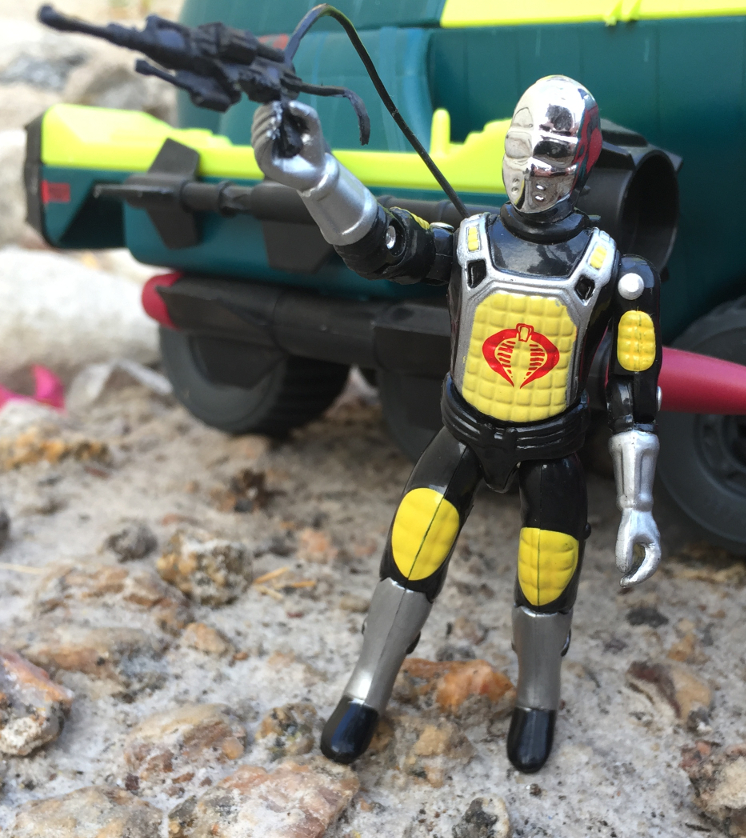
Cobra De Aco, Brazil, Steel Cobra, Estrela, Black Major, Factory Custom, Red Laser Army, Bootleg, 1988 Bugg, Secto Viper, 1986 Bats, Battle Android Trooper

Cobra De Aco, Brazil, Steel Cobra, Estrela, Black Major, Factory Custom, Red Laser Army, Bootleg, 1988 Bugg, Secto Viper, 1986 Bats, Battle Android Trooper, Cobra Trooper, Cobra Soldado

Cobra De Aco, Brazil, Steel Cobra, Estrela, Black Major, Factory Custom, Red Laser Army, Bootleg, 1988 Bugg, Secto Viper


Cobra De Aco, Brazil, Steel Cobra, Estrela, Black Major, Factory Custom, Red Laser Army, Bootleg, 1988 Bugg, Secto Viper, 1986 Bats, Battle Android Trooper


Thursday, September 3, 2020

1993 HEAT Viper - Around The Web

This HEAT Viper repaint isn't great.  But, the bright green is actually kind of fun and makes for a visually striking action figure.  Done differently, the figure still has some limitations.  But, one of the great customs of the early online Joe community was a Snake Eyes using the chest from this figure.  It proved the sculpt had potential.  Oddly, the figure was released in Brazil as a good guy, Raio Verde.  But, the figure was also in bright green and isn't all that different from this version.  I do enjoy this guy, though, for what he is and it's nice to have a couple of them lying around.  Here's the best of the 1993 HEAT Viper from around the web.


1993 HEAT Viper, Battle Corps

1993 HEAT Viper, Battle Corps, Bulletproof, DEF

Tuesday, September 1, 2020

2006 Viper - Viper Pit

Army building is heavily a phenomenon of adult collecting.  It spawns from the fantasies that we all had as kids of owning as many toys as you could possibly want.  Truthfully, army building something to great degrees is probably extremely unhealthy, obsessive behavior.  But, in collecting circles, it's not looked upon as that.  Instead, it is celebrated.  It is a cause of jealousy.  And, in the early 2000's, it was the fastest way "in" to be considered a "serious collector".  Back then, though, it was all about army building at retail.  In the end, all it proved was that you were good at shopping.  Despite collectors clamoring to buy up every retail army builder they saw during that time, Hasbro was able to sate demand.  Every few months, new army builders would appear.  Rarely were they perfect.  And, most times, they were downright flawed.  As the swan song of the Joe line, though, Hasbro dropped one final army building set on the collecting world.  At first glance, it was perfect: six classic Vipers done up in classic colors.  There was no way it wouldn't be a hit.  And, a hit it was.  So much so, that Hasbro did a second production run to get them into collector hands.  But, in the 14+ years since this set debuted, the flaws that were apparent upon its release have only become more pronounced.

If you were a fan of this set, or if you weren't a fan of this set, it was maddening.  If you loved 6 of, essentially, the same figure in colors like very common (and falling in price) original Joes, this set was frustrating because Hasbro only ever delivered two army building sets in that vein.  The rest featured characters, odd mold choices or bizarre colors.  If you didn't like this set and wished they had gone with a variety of Viper colors as the line's final send off, well, you knew that your desires would never be fulfilled.  Either way, though, collectors bought the set up.  Knowing it was the final release in the line helped to drive demand.  But, the fact that the 6 Vipers in the set were excellent stand ins for the original figure (and, in some ways superior) only helped the set's popularity.

But, with heavy purchase volume came issues.  The corners that Hasbro was cutting in terms of design and materials came to roost on this set.  The o-rings were bad.  The joints were stiff.  And, worst of all, the crotch piece was not properly designed with the upper legs and many collectors simply sheared away the little piece of plastic just by trying to sit the figure in a vehicle.  The drooping heads that were a hallmark of all Vipers released from 1997 and on were even more pronounced on these figures.  All of these issues combined to make the figures not only awkward to pose, but a downright liability to move around for fear of breakage.  All these years later, this set's poor quality continues to be it's hallmark and comments sections are filled with criticism of these figures for their brittle nature.

The actual set, though, did look good.  It included one gold face plated Viper and 5 silver faced Vipers: the subject of this profile.  The paint masks on the set were convention set level quality.  This figure features two-toned gloves, a very finely detailed Cobra logo, silver buckles on his chest and metallic grenades.  He features substantially more paint applications than the 1986 Viper.  And, even more than the retail Vipers that Hasbro had been pumping out since 2002.  From a pure aesthetic point of view, this was one of the best Vipers ever produced.

As this was the final Joe product to be released before the anniversary debacle, I bought this set heavily.  I figured I'd never regret getting cheap Vipers.  And, back then, I still had delusions of a massive collection display that would include a magnificent Cobra rally.  But, even if that didn't come to fruition, having a large quantity of Vipers available for photos, dios and just general purpose was enticing.  And, in the package, the set didn't disappoint.  But, once opened, the quality issues that others found also limited my use of these figures.  To this day, the figure rarely appears in any photos because the figures are so difficult to pose.  

Personally, I enjoyed the Viper Pit's weapons.  The Ambush rifle in grey is decent enough.  The fact that I had used the version of it from the 1994 Flint with my 1994 Vipers also gave it a nostalgic bent for me.  The little pistols were nice add ons.  The 1992 Gung Ho backpacks are fine.  The big win, though, was the inclusion of the machine guns.  This sculpt was from a JvC era figure.  But, it worked well enough with the ARAH figure scale.  And, it looks great with the Viper.  I've always liked Vipers or Troopers to be self sufficient.  So, Troopers having heavy machine guns, mortars or bazookas was fine by me.  The Viper including this machine gun works in the same vein.  It allows the Vipers to have heavier fire support and makes them a more formidable force.  To me, this was the only value in the Viper Pit set.  I was able to get some cheap Vipers that had different weapons to use.

Beyond that, though, this set's value is limited.  If you want to stand them all up in a row on a shelf, this set looks really nice.  The excellent paint masks and solid gear make for a visual treat and one of the better looking figures from the repaint era.  But, that's the extent of their use.  Once you want to use them in photos, dios or displays, the severe limitations of the poor quality become way to apparent.  You can't really pose the figures and any sudden movement may leave you with a snapped crotch.  Over the years, I've tried to get them into more photos.  But, the stiff legs hinder even cautious movement and I've had more than a dozen of the o-rings snap just in proper storage.  So, the figure's visual appeal is more than offset by the quality issues and that has left these figures with a legacy that is far below what a cursory visual inspection would imply.

One fun fact about this Viper Pit set is that it included one filecard for all 6 figures.  We do not know the production runs on this set.  At the time, Toys R Us ordered around 20,000 Cobra sets when they sold vintage Joe 6 packs.  But, they also only ordered around 16,000 Joe themed sets of the same product.  It's likely that the first Viper Pit production run was in that ballpark.  The initial production run sold out at most online dealers relatively quickly.  Hasbro then produced a second, distinct run of the figures to help sate demand.  And, sate it, that extra run did.  The second production run lingered at retail and quickly stagnated as collectors had moved on and the anniversary collectors who were starting to come online didn't care about vintage style Joes.  As late as 2013, you could still buy packaged sets at dealers for original retail cost.  The filecard and production numbers are related, though, in that there is, at best, one filecard per every 6 figures that Hasbro released.  This means the filecard is, likely, one of the rarest filecards per figure in the line's history.  It's not a great filecard.  But, the fact that only 1 in 6 figures at max could possibly have the filecard, it's worth noting and holding onto any filecards you may have.

My final take on these figures is that, for the right price, they are good stand ins for the classic Viper.  But, that's about it.  Among the late Viper repaints that Hasbro created after 1994, this version falls in the middle.  The paint masks make it more interesting than most of the retail Vipers of the 2000's.  But, the 1998 Cobra Trooper and Officer and the 2002 Crimson Viper match the paint masks and have the added benefit of bringing something relatively new to the mold in terms of coloring.  So, that also means this figure is something skipable.  I'd rather have a ton of other figures than these Vipers.  But, the realities of retail in the 2000's made it possible to acquire a large amount of these figures.  And, the economic realities of the early 2010's when I went to sell off a large part of my collection meant that these figures were worth less than retail and weren't worth selling at that time.  So, even today, I have a massive bin full of these Vipers...that I never use.  Every now and then, I'll check on them to find a few more have snapped their o-rings.  But, that's about the extent of their value.  In today's market, it might be worth exploring their trade potential.  But, again, that's about all the purpose I can find for them.

Viper Pit Vipers are oddly priced.  Loose, mint and complete figures sell in the $12-$15 range.  (Dealers sell a farcical amount at $20, too!)  But, you can get an entire set of 6 loose figures for around $40 with a little patience.  That's a far better deal.  Dealers tend to sell loose and complete sets for about the same price as carded sets.  But, even carded sets top out around $60 in the open market.  That's quite a jump from where these figures were just 5 or 6 years ago.  But, it's also not nearly the leap we've seen with some of the other 6 figure sets that were produced in the same time frame.  But, collectors bought all of the Viper Pits and the later production run put way too many into the marketplace.  14 years after the set's release, this means that people can now get the figures for not too great a markup.  But, the relatively poor design choices have left this Viper as a poor substitute for the original and the demand for this figure reflects that.

2006 Viper, Viper Pit, DTC, TRU Exclusive, GHSB, Steel Brigade, Black Major, Gold Head Steel Brigade

2006 Viper, Viper Pit, DTC, TRU Exclusive


2006, Viper, Viper Pit, Cobra Viper, DTC Exclusive, TRU