Wednesday, May 23, 2007

1983 Tan Grunt

I'm not a big fan of the early Joe figures. Sure, they have their place in history and are worthy of respect for that fact, but the reality is that they were greatly paled by the later Joe releases and were largely made irrelevant by subsequent, better detailed figures. As such, though the years, I have profiled very few of the original figures. This is somewhat a shame as these molds have had far more interesting lives than those of most other figures even if their actual designs have become dated. The subject of this profile, though, is the first true repaint of a character that was offered in the Joe line. For that, he is significant. But, it's what became of this figure in modern collecting terms that is the figure's true legacy.

In 1982, Grunt was the face of the Joe line. It was his card art that adorned most non-toy Joe merchandise and it was his image that came to represent the line as a whole. As such, it's fitting then, that Grunt was also the first character in the line's history to get the repaint treatment. (This isn't to say that Grunt was the most important or interesting character, he was just the guy who appeared on a lot of non-figure merchandise in the early years.) The Glider's were heavily hyped toys and it made sense to have figures that were at least somewhat known as the pilots. (Never mind that it made no sense for a ground pounder to be the glider expert.) The new color didn't really fit in with the color of the Glider, but it did offer something very distinct from the original Joe colors.

Oddly, this was one of the first obscure figures I ever owned. While just about all my friends had the standard, retail Joes in '82 and '83, the glider figures were less common. As far as I can remember, the reason for this was that my parents purchased the Falcon glider for my brother. Within a few hours, he had broken it to the point of uselessness. The shoddy construction simply could not withstand the hearty play of a 7 year old. My parents spread this information to other parents as the gliders were (relatively) expensive toys and they didn't want others to waste money. As such, we remained the only kids we knew who actually had the tan Grunt figure.

For a long time, though, I ignored the figure. Sometimes, I had him work with Doc since both were tan. In early 1984, though, this figure became more important as I added a V1 Duke to my collection. Duke was similar enough in color to this Grunt that I finally had use for desert figures. When Dusty was released in 1985, I had a full desert team of which this Grunt was an important member. I outfitted the figure with an accessory pack Grunt backpack (which perfectly matches this figure) and an accessory pack M-16. As such, this was a perfect copy of the original Grunt...a figure that had long been destroyed by my younger brothers. (In fact, it was on this version of Grunt that I first noticed the silver painted knife. I had missed that on the original figure because it had been destroyed so quickly.)

After a short run on the desert team, though, Grunt faded away. The reality was that the new figures simply made this mold seem outdated and it was hard for me to fit him in with new faces like Flint, Snake-Eyes and Footloose. So, the figure fell deeper and deeper into my old figure box and remained there for some time. When I finally dug him out in the early '90's, I found that someone had been using the figure and broken both his thumbs. I then replaced the figure's arms with those from an old V1 Duke. I rolled him into a plastic bag and forgot about him until early 2000. At that point, I realized that the figure I had been counting as part of my collection was actually nothing more than a custom at this point but I really didn't care enough about the figure to acquire a new one until just recently. My new figure that you see below will be used for these photos and then put away. I simply won't have any use for him unless I want to take a nostaligic picture with lots or original figures. Beyond that, this mold has been replaced in my collection.

The Grunt mold had a long, productive life. After the three unique (straight arm, swivel arm, tan) uses in the US, the figure then surfaced in Argentina (though, in Argentina, the Falcon Glider actually included a tan colored, straight arm Zap figure rather than Grunt), Brazil and then showed back up in the US in the 1997 Stars and Stripes set. In Argentina, the Tan Grunt was released on a single card and was a new character named Sokerk. (This is the harder version to find. The Sokerk made from the Ripcord mold is more common.) The same mold was then released in Brazil as Estopim. So, aficionados of this mold have many different variations of the mold to track down.

On the surface, Grunt should be only slightly easier to find than the Viper Pilot. In the early days when you bought figures out of childhood collections, this was largely true. (However, it was still more difficult to find a mint Viper Pilot than a mint Grunt.) Now, though, Tan Grunts are easy to find and very cheap. The reason for this brings up an interesting point regarding Joe collecting that really speaks to how broad collectordom really is. The reason that Grunts are so available is because one single person purchased a huge amount of them and later divested them on the secondary market. This person had purchased hundreds of mint-in-bubble Tan Grunt figures (I don't know if he was able to buy them from Hasbro directly or if he acquired them from secondary market sources in the '80's and early '90's.) as well as hundreds of bubbled V1 Grunt figures. His plan was to use them in a grand military diorama. But, those plans never came to fruition and he sold his entire stock to a Joe dealer. This dealer then offered the figures to the collecting community for ridiculously low prices. As such, many collectors were able to bubbled Tan Grunts and open them for pristine versions of a figure that should have been hard to find. The point of this is that a one person can have an affect on the supply of aftermarket Joe figures to the point where a rare figure is available to point of commonality.

The effect of this is that Tan Grunts are cheap. Mint and complete, they rarely run more than $6 or $7. The filecard is a bit harder to come by as the dealer purchase did not have filecards. But, even that doesn't make the figure expensive. This version of Grunt remains about the cheapest '82/'83 figure to acquire. The cool thing about this is that you can buy several Tan Grunts, add a few Tan Clutchs and maybe a Duke or two for variety and you can re-create several of the original '83 Joes in desert garb. As the V1 accessory pack weapons match this color scheme, it is a creative way to build an alternative look at the original Joes. Beyond that, though, there isn't much need for this figure. As a completist, I recommend buying one now while prices are still good. History has shown that demand will, eventually, overtake the supply of figures like this and you will see prices rise. This is a figure well worth his current price, but I'd be hard pressed to pay too much more for one.

1983 Grunt, Falcon Glider, Breaker, Flash, Hawk, Rock and Roll

1983 Grunt, Falcon Glider, Breaker, Flash, Hawk, Rock and Roll

1983 Grunt, Falcon Glider, 1984 Spirit, 1990 Sky Patrol Airwave

1983 Grunt, Falcon Glider, Breaker, Flash, Hawk, Rock and Roll

1983 Grunt, Falcon Glider, Breaker, Flash, Hawk, Rock and Roll

Thursday, May 17, 2007

Funskool Big Boa

I will start this profile with a disclaimer: I hate Big Boa. I despise this figure mold and all of its incarnations. I hated it from the moment I first saw it. There was just something about the look of the figure with the S&M torso, odd helmet and circus coloring that made me despise the figure. Really, though, Big Boa is no more buffoonish than Raptor or Crystal Ball and while I don't care about those figures, that's the end of my feelings on them. Only Big Boa incites such hatred. For years I've avoided the figure but my recent acquisition of the Funskool version (stupid quest to be a completist!) brought the figure back into the forefront of my collection. With a little reflection, I've gotten to the core as to why I hate the figure so much and that has lead to a begrudging appreciation of the character.

The simple reason why I hate Big Boa is because as a character, he's really cool. The idea of a Cobra trainer who is so tough that even the Cobras bend to his will perfectly fits with my vision of Cobra. The frozen turkey sized fists and bull horn voice from his filecard were lasting images from my childhood. The character was a specialty that was needed and the resulting design was just perfect for what Cobra was. The problem is that the figure mold is simply terrible. It was a tragedy to see such a great characterization wasted on so horrid a figure mold. That is the source of my hatred. The simple reason is that the figure was so useless for such a great addition to the pantheon of Cobra characters was enough to forever sour me Big Boa.

Originally, Big Boa was not intended to be the Cobra trainer. Instead, he was designed as the Cobra counterpart to the planned Rocky Balboa figure. Big Boa would have been Rocky's main opponent on the Cobra side. Big Boa's boxing gloves and speed bag were intended to convey this rivalry and were planned as a great play pattern for kids. However, the Rocky figure never came to be. Hasbro quickly had to scramble to remove him from their lineup. But, Big Boa was too far into the process for Hasbro to eat the costs for his development, too. So, the figure was re-classified as the Cobra trainer and released with his full complement of boxing gear anyways.

1987 was a terrible year for Cobra characters. Really, it was. But of the 4 new characters who comprised the main retail line Raptor and Crystal Ball can be ignored. They have their cult followings, but neither really offered all that much to the line that they had to be considered. Croc Master was a decent enough design that he found use. He isn't an integral character and were he never created, there would be no desire for such a specialty to appear in the modern line. Big Boa, though, filled a niche that simply could not be ignored. Cobra troops needed a trainer. It is a position that every military has. That makes the figure somewhat relevant: regardless of its poor design.

At the core, it is the necessity of Big Boa's position that leaves me wanting so much more. This figure delivered a character that had potential, but gave us a design that suggested something much different. Due to the poor mold, my Cobra is now devoid of a trainer. Were I to create my own figure for this role, it would certainly incorporate some of the elements of Big Boa. But, to do so seems redundant since there is already a character out there...his figure just sucks.

Which leads to my collection. As a kid, Big Boa was the one loser who always died some horrible death almost immediately. He would be ripped to shreds by wild dogs in a debris field. He might fall into a crocodile pit. Or, he might end up boiled to death in a pit of wax. Basically, my deep hatred for the figure manifested itself in horrific ways. I used quick, but painful deaths as way to show my contempt for the figure. Beyond my childhood years, though, the figure has no presence at all. In fact, in the late '90's, I had even decided that Big Boa would not be part of my collection. But, after I got one in a large lot, I figured I might as well keep him as the day would come that I was a completist and the prospect of going out and paying for a Big Boa figure by itself was less palatable than just keeping the one I had acquired with other figures. Now, not much has changed. I have Big Boa figures for completion's sake, but that's about it. This profile has brought out the root of my dislike of this figure and has lessened my contempt for Big Boa. But, it has not moved Big Boa to a place where I'd ever like to see another one. But, were Hasbro to put together a nicely done, new version of the Big Boa character, then I think I might be interested. You just aren't going to hear me leading the call for an updated version of this character in any format.

The Big Boa mold actually was quite the world traveler. After his initial release in the US, his body was repainted in 1993 and used for the Street Fighter Balrog figure. Almost immediately after that, the mold made its way down to Brazil. Here, it was released with a black helmet as a character named Kangor. (As a note, Kangor has great card art that makes it look like he's boxing a kangaroo!) The mold then showed up in India where it was released for many years. The Funskool version is very similar to the US version, but lacks the paint details on the helmet and does not include the face hose that was a hallmark of so many '87 Cobras. It was still being produced in India into 2003 and it is likely that Hasbro has access to the mold again. While I don't think that the entire thing should be used again, I think the head could be dusted off and amalgamated with some other parts to make a new and improved Big Boa figure.

If you want a Big Boa, just spend $4 and buy a carded version. The time is coming when Funskool figures are going to dry up and those who missed on their cheap availability will be forced to spend higher prices for the figures on the secondary market. While I don't foresee Big Boa ever being a $10 figure, I really don't see any reason to add even a dollar or two to the price when he is currently readily available. That being said, this was one of the last Funksool figures I added to my collection. I only bought him for completion's sake and that is the extent of his use. From a pure design perspective, the American figure is superior. But, this figure has its place and can find a home in most collections.


Wednesday, May 9, 2007

1988 Night Force Psyche Out

1987 brought us some interesting Joes. Having filled many of the military positions with figures from earlier in the line, 1987 brought us many "civilian" type specialties with the new figure offerings. Some were nicely done (like Chuckles). Other, left something to be desired. In the case of Psyche Out, the character is interesting, but not all that useful. His case wasn't helped by a bright green figure. In 1988, though, Hasbro offered a more sanely colored version of Psyche Out. It still didn't change the fact that they were asking kids to play with a psychiatrist, but at least the colors lent themselves to use.

The reality of Psyche Out is that he's a boring figure at best. Really, what's he going to do? Were kids really expected to play out a scene with Psyche Out listening while Falcon was lying on a couch and talking about how being in combat made him feel? That wasn't exactly the type of play pattern that lead to successful toy lines. But, like many characters in the vintage line, Psyche Out was made by Larry Hama and the manner in which Psyche Out was portrayed in the comics. There, Psyche Out was more of a psychological specialist who was able to get inside the head of the enemy and predict their moves. In this capacity, the character worked great. Unfortunately, even with this defined purpose, the character was rarely shown outside of a base setting. Psyche Out simply wasn't a combatant and it was difficult to use him as such.

As a kid, this was where my issue with Psyche Out lie. He simply didn't have enough of a purpose to match the manner in which I wished to play. What he did have, though, was those funky radar dishes on his arms. I used those as electronic projection devices that were able to disrupt communications, beam low level paranoia waves to Cobra troops and cause general havoc. That was fun...once. After that, it didn't make for much of a long term story. So, I had Tele-Vipers quickly figure out what was happening and then outfit all Cobra troops with helmets that filtered out Psyche Out's secret beams. After that, Psyche Out pretty much became an afterthought in my childhood collection.

Fast forward to adulthood, though, and Psyche Out has taken on new respect. Psyche Out's specialty is one that is more nuanced and appreciated as you get older and he slowly grew into more and more of a Joe commander. While he didn't actually lead missions or troops, he was a high level consultant on just about every operation. Psyche Out was involved from the beginning of each mission where he would match the psychological profile of potential Joes to the mission. He would use that info to pair Joes into units that would get along, be able to handle the mental stress of the mission as well as fulfill the skillset required to complete the objective. In that role, Psyche Out often chooses teams that look less effective than those done on pure paper. He would assign arctic specialists to jungle missions and other "crazy" ideas. But, Psyche Out's version of a team was the one that functioned best.

As such, if Snow Job and Gung Ho are perfect battlefield complements to each other, then it makes sense to pair them on a mission in lieu of more qualified Joes who don't have that type of battlefield chemistry. The result is a team that is better functioning and is more efficient in achieving mission successes. Psyche Out would also be part of the mission planning where he would learn the players who were involved on the Cobra side and then help predict their behavior. This then helped Psyche Out also pick Joe team members who often made little sense. (One such example was when Psyche Out dispatched Cutter and Wet Suit to the desert to break up a Cobra oil siphoning project. It appeared ludicrous except that Psyche Out correctly predicted the Cobras would run for the coast. They did so and the Joe aquatic specialists were perfectly placed to apprehend the fugitive Cobras.) Psyche Out's judgement is trusted, though, due to his high success rate. Psyche Out is also used as part of mission debriefing. He uses that information to flesh out personnel files of the mission members, update his notes on Cobra behavior and also ensure that there are no lingering psychological effects from the mission that are going to bother the Joes in the future. (As a note, Psyche Out has one noted failure in this regard. After a disturbing mission onto Cobra Island in 1995, Duke pretty much went off the deep end and has not come back. There was nothing about Duke that previously indicated he wouldn't be able to handle what happened. But, none of the 3 men on that mission have ever fully disclosed what, exactly, happened. So, Duke's breakdown remains somewhat of a mystery to Psyche Out.) So, while the Psyche Out character now gets more use in my collection, he still isn't actually used. The figure is always posed in the Joe HQ. Here is consults with Hawk, General Flagg, Keel Haul and other Joe officers. But, he rarely leaves the confines of the base.

Now that I have this Night Force figure, I have more combat options for Psyche Out, but I still don't see him getting much use outside of the HQ. As a figure mold, Psyche Out is actually quite good. The figure is richly detailed, yet simple enough that you can appreciate his place in the line. The Night Force version is nicely colored in blacks, greens and greys. (Psyche Out is one of the few Night Force figures who is a substantial improvement over his regular figure.) He features a nice complement of accessories, but the radar dishes and wrist gauntlets are now kind of silly. Psyche Out's pistol is one of the nicer small weapons in the line and was one of my de facto pistols for any figure who needed one for many years. Fully loaded, though, Psyche Out loses something. He is a character who I view as being there for his mind. So, he does not need the accoutrement's which are included with him. (The pistol is decent to have, though.) He simply is there to think, talk and plan. When it's time for action, Psyche Out makes himself scarce.

The Psyche Out mold saw some interesting uses. After it was released in its original incarnation in 1987 and 1988, this Night Force figure was created for a short run. After that, the timeline gets a little fuzzy. It seems that sometime around 1990 or 1991, the figure mold was used by Hasbro to create the European exclusive Tiger Force Psyche Out. Then, sometime around 1992, the mold made its way down to Brazil where it was released in colors similar to the V1 American figure and was named Tele-Mentor. After that, the figure has not appeared again. However, several of Tele-Mentor's Brazilian contemporaries ended up being produced in India. So it is possible that the mold was sent on to Funskool and they simply chose not to use it. Of course, it could still be lost in Brazil or in the control of Hasbro just waiting for another release.

Truthfully, though, even if Hasbro had the mold, I don't think we'll see the day where this figure is released again. And, with the Night and Tiger force versions out there for acceptable prices, I don't think collectors would really mind. Like all Night Force figures, Psyche Out is somewhat tough to find. But, like all other Psyche Out figures, he is substantially cheaper than all the other figures in his subset. The Night Force version, though, features a wide range of small, easily lost accessories, so it is common to find the figure missing his arm bands and the radar dishes that attach to them. Really, though, if you're looking to use the figure in your collection, these pieces are superfluous as most of the accessories from the original Psyche Out work very well. As such, you can get this figure for under $10 if you are willing to sacrifice completeness. As a part of a collection, Psyche Out doesn't offer much excitement. He can fill a diorama, but that's about it. As such, I wouldn't go out of my way to find one as, aside from completion's sake, you will be hard pressed to get your money's worth our of this figure.

1989 Night Force Psyche Out, TRU Exlusive, 1985 flint, Skeres

1989 Night Force Psyche Out, TRU Exlusive, 1985 flint, 1993 General Flagg, 1986 Havoc, Cross Country

1989 Night Force Psyche Out, TRU Exlusive, Lt. Gorky, Oktober Guard, 2005 Comic Pack Flint, 2003 Convention Exclusive Major Storm, Alpinista, Hit and Run, Brazil, Estrela

Wednesday, March 21, 2007

1986 Dr. Mindbender

In the pantheon of Cobra characters, Dr. Mindbender is certainly near the top. One of the most recognizable and oft-used Cobra lackeys in Joe media, Mindbender is the perfect villain: vainly and oddly dressed, egomaniacal and overly ambitious. Why, then, have I only visited the character one time in 7 years of profiling figures? I think the answer lies in the fact that there really isn't a released ARAH version of Dr. Mindbender that lives up to his characterization. His second version is bright neon, even if a solid mold. The original figure, and subject of this profile, is better, but still has some of the goofiness that keeps it from being great.

Dr. Mindbender went through quite an evolution in the design process. He was, at times, a circus performer, a former professional wrestler and went by the Dr. Brainwave. The final character that was settled on for this design, though, was an orthodontist who experimented with the brain as a means of pain control. He then went mad after experimenting on himself. This works on many levels as it establishes the character's intelligence but also gives him a comic-book type origin that reconciles with his outlandish attire. The figure itself his a mash of flesh and purple. When adorned with his signature cape, the figure is set against a nice black backdrop. The mold is tightly designed and features the details that were the hallmark of earlier Joe molds. His has pushbroom mustache and a monocle that define his countenance. They are the characterizing marks (like Major Bludd's eyepatch) that enable Mindbender to remain a villain even though his full face is exposed. His ensemble is completed with oversized boots and metallic looking suspenders that were, no doubt, used to accentuate the good Dr.'s abs. The colors do work well together, even though they were a departure from earlier Cobra villains.

In my collection Dr. Mindbender is less Cobra strategist and more mad scientist. I have had the Dr. recover from his horrid scarring that was evident on the unreleased 1995 figure, but have left the mental scars of being such a monster behind. These days, my Mindbender roams a dark, underground laboratory on Cobra Island where he creates genetic mutations and works to perfect surgical and chemical methods of enhancing human strength, intelligence and endurance. In these depths, Mindbender is more of a spectre to most of Cobra. He has a dedicated group of "Acid-Vipers" (the purple 2002 Viper figure) who do his bidding. When they are seen above the surface, it means either that the Dr. has achieved a breakthrough in his research or one of his monstrosities has escaped and is once again terrorizing Cobra Island.

With this characterization, Mindbender is no longer a trusted member of my Cobra hierarchy. He remains a powerful ally to those in power as Mindbender holds the keys to the most horrid dungeons and torture chambers in the world. That alone makes him worth having around. This leads to those in power tolerating Mindbender and placating his needs. He has an ample research budget, a wealth of human test subjects (with no pesky moral guardians to keep him from destroying them in any manner he sees fit) and free reign to conduct his experiments. When something goes wrong, the full might of the Cobra army is at his disposal to eliminate and problems that escape his lab.

I view Mindbender as a man of incredible intelligence whose moral compass was lost in his accident. As he has experienced disfigurements beyond the recognition of most people, Mindbender has fallen even deeper into the depths of his black mind. He doesn't flinch at the most gruesome tortures or experiments. His mental illness is simply so far gone that he lost all human compassion. His minions of Acid-Vipers share this mentality. When he ventures from his lab, though, Mindbender can still show glimpses of his former self. He is still rational and listens to those above ground. Once in his lab, though, all bets are off and he is capable of acts that defy description.

One of the reasons why Mindbender has become such an ghost of his former self is because none of his figures really give me the look I can imagine for someone of Mindbender's established, canonical character. While this mold is excellently designed, he still looks like a circus strongman. It's hard to take him seriously in a militaristic organization like Cobra when he's dressed like a sideshow attraction. Thus, I had to find other uses for the character. My development of Mindbender keeps him in the minds of the other, more figure-friendly Cobras, but also keeps Mindbender's figure out of the limelight.   Don't get me wrong, though. I like this version of Dr. Mindbender. As a design, it is quite good and fits with his super-villain personality quite well. The mold is well adorned with small detail, solid paint applications and great accessories. His cloth cape was one of the best ever offered in the vintage line and remains a staple of the character to this day. Like other characters such as Raptor and Big Boa, though, the actual design of the figure simply no longer fits with the look of my Cobra hierarchy. Until Hasbro releases a new ARAH style Dr. Mindbender, the character is doomed to his more obscure role in my collection. This is too bad as I do like Dr. Mindbender as a character. His influence over Cobra shaped much of how my current Cobra world is structured. His role in Serpentor's creation generated political fallout that is still felt almost 2 decades after that scientific achievement.

After its use in the US and Europe, the V1 Dr. Mindbender mold was sent down to Brazil. He was released there as part of the Iron Grenadiers subset. After that, the mold never surfaced again and is presumed lost in South America. (Mindbender's Brazilian contemporaries included the Astro Viper and V2 Destro, both of whom have resurfaced but also Overlord and the Iron Grenadier, both of whom are lost.) This was the fate of both retail releases of Mindbender as his '93 figure was also released in Brazil and never appeared again. As such, Dr. Mindbender has not been revisited in ARAH-style since the rebirth of the line in 1997. He is one of the biggest characters who has yet to appear. But, since any appearance would require retooling of at least the character's head, it is unlikely that we will see a Dr. Mindbender figure in the near future. If you collect new sculpt figures, one of the highlights is the 2003 Dr. Mindbender in a lab coat. This is a more scholarly Dr. Mindbender and an idea that would be welcome in ARAH style.

Time was, Dr. Mindbender figures would set you back a bit. I distinctly remember selling a complete version for ~$15 back in late 2000. They climbed a bit above that in 2001 but have since fallen quite a bit and can now routinely be had for ~$11 for a mint and complete version. As the figure's mustache is very susceptible to paint wear and it is unlikely we'll ever see this mold again, that is probably a fair price for a pristine specimen. I keep two of this figure in my collection (one for display and one for use) as the character is so important. Mindbender is a staple of pretty much every Joe collection and still stands as one of the best developed Cobra characters. It's just too bad there aren't more figures choices to represent him.

1986 Dr. Mindbender, 2006 Viper Pit

1986 Dr. Mindbender, 2003 BAT, Overkill, 1987 Techno Viper, 1994 Major Bludd


Wednesday, March 7, 2007

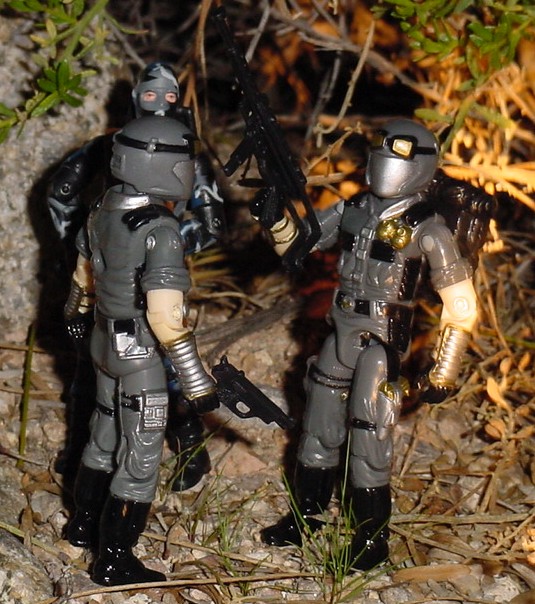
1998 Cobra Officer

In 1998, Hasbro released their second wave of Toys R Us exclusive figure sets. The sets from 1997 had sold well to a starved collector base, even though their quality left much to be desired. The '98 assortment was also geared towards collectors but featured much better quality than that of the previous year's figures. It still featured a plethora of newly released molds, collector favorites and more army builders. The crown jewel of the '98 3 figure packs was the Cobra Infantry Team. It featured two Vipers in Cobra blue and the subject of this profile, a grey Viper mold named the Cobra Officer. It was widely loved by collectors and the Infantry Team figures became a staple of collections. In the years that followed, the Viper mold was made largely irrelevant by a multitude of releases of other army builders and a new influx of collectors who had missed this Cobra Officer at retail focused their attentions instead on a new crop of retail army builders. Looking back, though, Hasbro got the Viper mold so right back in '98 that no subsequent retail release has lived up to these high quality gems.

For my money, the greatest army builder set that Hasbro has released since 1994 was the 1998 Cobra Infantry Team. It featured only army builders in classic colors, great accessories and all for a bargain price. Since then, Hasbro has tried many other army builder ideas but all have fallen just short of the brilliance that was their first attempt. This isn't to say they are bad, but, from a pure army building perspective, they failed to live up to the standard set by the original. The Python Patrol featured colors that were too offbeat. The Cobra Infantry 6 pack came close but just loses out to these figures due to the horrid accessories in the Toys R Us exclusive set. The Urban, Ninja and Crimson Guard set all featured too many characters to be in contention. The Night Watch was also close, but lost on mold choice and, again, lesser accessories. The Viper Pit got the accessories right, but the lack or originality coupled with the poor quality of the figures still gives this original Cobra Infantry Team the edge.

This figure holds a special place in my collection for a couple of different reasons. First off, back in late 1998 when I first acquired it, he was among a very small group of Joe figures that comprised my collection. This lead to the figure getting lots of use as he was, basically, the entire sum of my Cobra collection at that time. The other reason why I'm fond of this figure is because of the circumstances surrounding the first time I found it at retail. I distinctly remember the Saturday in December of 1998. I was moving apartments at the time and took a break when it started raining. My roommate and I went to get lunch and I stopped in a local Toys R Us. There, I found most of the packs and then proceeded to stand in a very long line to buy them. The other reason I remember this day so vividly, though, is because it was that night that I first met my wife. So, I associate this figure with great memories all around.

The 1998 Joe figure sets actually shipped on at least 3 distinct occasions. The first shipments appeared in very late 1998. These were readily available for about 6 weeks before 1999 began. By '99, though, Hasbro had shifted their production facilities away from Joe and were fully focused on producing massive amounts of Episode I product. In the summer of '99, though, Hasbro was able to squeeze in another full production run of the '98 Joe figure sets. Again, these weren't terribly difficult to find, but the Infantry set and the Cobra Polar Assault did sell out again in another 6 or 8 weeks. But, if collectors had missed both of these opportunities, Hasbro came through again in late 1999 and produced one last allotment of these figures for the Christmas holidays. Again, if you were hitting retail during this 6 to 8 week period the Cobra Infantry was not hard to find. But, if you missed these sets all three times, you were then out of luck.

The '98 Cobras actually feature the most intricate paint masks of any Viper molds released in modern times. In fact, they are actually more intricate than even the 2002 Convention Vipers. Their one fatal flaw is the lack of a Cobra sigil. As I've said before, though, I don't consider that a terrible thing. Cobra would not, necessarily, want to advertise their soldiers when they invade foreign lands. While it would be nice to have a sigil, it's not something that ruins the figure for me. What is interesting to me, though, is that Hasbro moved to such bland paint masks for its later retail release Vipers. The '98 paint masks had already been created (which is the most expensive part of the process) and had proven to work. As such, it didn't make much sense for the later Vipers to feature such reduced paint applications. I have a feeling that was done to make the Convention figures more special and Hasbro also realized that collectors would buy any Viper mold: regardless of how little effort Hasbro put into the figure. (Though it is odd that the Viper Pit with the solid accessories, colors and paint masks are warming the pegs at a greater rate than any other modern Viper.)

If you look at this figure, you can really start to appreciate the detail that went into it. The figure only really features 5 colors: grey, silver, gold, black and flesh, but the small details that had paint applications make the figure much more visually interesting. If you look closely, you can see that the figure's wrist gauntlets actually feature not one color, but two. They are thinly lined with gold. The figure's sidearm also features a differently colored pistol than holster. The figure even features a thin band of silver ringing his collar: separating the head from the torso. It is these small details that that set the '98 figures apart from the multitude of later Viper mold releases. It makes this figure look like more a leader since his uniform isn't as bland. It is also one of the reasons why this figure has remained popular despite the fact that Hasbro has subsequently released a large number of Viper molds.

The other area where the '98 figures succeeded was with their accessories. All of the '98 Cobra Infantry figures featured the standard rifle with removable stock, full field backpack, combat pistol and a black battle stand. While not the traditional Viper accessories (the entire accessory complement was a repaint of that originally included with the 1991 Dusty figure) they perfectly fit the figure's purpose. These were truly the accessories of a field infantry soldier. There was no need to look beyond what was included with the figure to give him fitting accessories. It was perfect right out of the package.

In my collection, this figure serves a few distinct purposes. He may simply act as an officer to the younger blue Vipers. He may also act as a night attack squad that supports Night Vipers. Or, he may join in urban assault squads as his grey meshes well with the black Urban Alley Viper. Many collectors used the figure as a Stinger Driver or night assault figure. But, mostly, I use the figure as the officer for which he was intended. However, my Cobra Officers are not officers in the traditional military sense. Sure, they do lead lesser skilled or experienced troops into battle and can be the hard task masters. But, they are chosen more for these qualities than anything else. Cobra Officers are often men who rose from the ranks out of the run of the mill Viper corps. They don't, necessarily, have any special education, though that may be their gateway to bigger and better things. (If you want to be a Crimson Guard in my Joeverse, you have to have a college degree at least.) They act more as enlisted commanders rather than full fledged, decision making officers. To give the Officer recruits the hard edge they need to discipline an unruly cast that makes up the Viper Corps, the final initiation rite into officerhood is for the new officer to kill a Viper from the officer's own unit. It creates the detachment necessary for an officer to do his job, but also showcases the ruthlessness that Cobra espouses in their lowest ranks. It also gives the lower Vipers more respect for the Officers since they know what the officer had to do to achieve his position.

Due to this requirement, the Cobra Officer rank is often as high as most recruits can get in Cobra. There are alternate career paths that avoid this pratfall and allow for Cobras to be better accepted in western society. As such, I see the Cobra Officers as more of the sergeants of the Cobra ranks. They keep the rank and file in line, carry out their duty with ruthless precision, but lack the real critical thinking skills to move on to battlefield planning or any position beyond leading a group of less than two dozen men. This makes them especially dangerous foes, as they have little regard for any life...even that of the men in their command. In fact, it is well known that a good officer will sacrifice his men if it means the success of the mission. As such, these aren't enemies who are welcome sights on the battlefield.

It's hard to believe that back in '98/'99 I bought 5 Cobra Infantry sets and not only had one of the larger armies around but also could not fathom how I could ever need any more of them than that. Back then, armies were smaller and more diverse. As such, I didn't even think about buying more than I had and ended up leaving dozens of these sets on the shelves. I did, though, pick up a couple of extra sets at Christmas in '99. I was planning to sell them in the first half of 2000. I fully expected the sets to appreciate to about $20/set and figured I might as well make a little money. For whatever reason, though, I never got around to selling my extra sets. This proved rather fortuitous. In 2001 and 2002, I simply had no money to buy Joes. (I made a bad life choice and have just now, finally, recovered from it.) As such, I had no means to acquire any new foreign Joes that were becoming available and fascinating me at the time. However, it turned out that both Brazilian and European collectors were very willing to part with high quality native figures in exchange for Cobra Infantry Teams. You see, by that time, these sets were easily fetching $50 on Ebay with some going as high as $70 on a routine basis. As I only had $10 in each set, I was able to trade very well for the vast majority of my foreign Joe collection.

The Viper mold was used only by Hasbro in 1986, 1989 and 1990. The legs, though, were separated from the figure in 1993 when they were used with the '93 Dr. Mindbender. This would not be of significance except for the fact that the '93 Dr. Mindbender mold was sent to Brazil sometime around 1994 and did not come back. This left the Viper's original legs lost. Hasbro, though, came up with a solid solution when they wanted to resurrect the figure in 1997. The combined two of the most popular army builders of all time and combined the Viper torso, head and arms with the V1 BAT legs. These legs are substantially skinnier than the original Viper legs, but have never really bothered me all that much. (Though, Funskool removed the copyright information from the BAT legs so the backside of all modern Vipers is a bit odd.) This newly amalgamated Viper was released in 1997, in 2 colors in 1998, in 2 retail colors in 2002 as well as 2 convention colors. (The Crimson and Fuscia Vipers do rival these '98's in terms of accessories, quality and design. Shame they are so expensive these days.) The mold was then released 3 times in 2003. None of these various color schemes were spectacular though many were solid. But, fans were a bit sick of the mold in late 2003 and Hasbro did not dust it off again until late 2006 when they remolded the original Viper thighs and created a third Viper construction type in the highly anticipated but poorly received Viper Pit set. This is a mold that Hasbro will dust off at any time they want to get collector attention and it is likely that if we ever see the return of ARAH-style Joes to retail, the Viper mold will be among the first molds to appear.

Production wise, this figure is definitely rarer than all the post '99 Joes that were released at retail. (With the exception of Wave V of the ARAHC figures.) But, it isn't nearly as rare as many people might want you to think. These were readily available at retail during three distinct periods of time and many collectors had a chance to acquire many of them. Plus, as the army building craze started to crescendo, many savvy collectors bought up the surplus Infantry Teams when they still sold in the $15-$20 range. Nowadays, this figure will set you back approximately $20 for a nice mint, complete with filecard specimen. MOC, you can get them for about the same price per figure and sometimes even less. Every now and then, this figure does see a drop in popularity and if you take advantage of that, you can get some good deals. Personally, I would not pay that for this figure any more, but I also have many which I purchased at retail so that certainly shapes my view of the figure quite a bit. Overall, this is still one of the most distinctive colorings of the Viper mold and is a great way to accentuate your Cobra armies.

1998 Cobra Officer, TRU Exclusive, 2006 Viper Pit, 1984 ASP, 2004 Flak Viper, Nullifier, Urban Assault

1998 Cobra Officer, TRU Exclusive, 2006 Viper Pit, 1984 ASP, 2004 Flak Viper, Nullifier, Urban Assault

1998 Cobra Officer, TRU Exclusive, 2006 Viper Pit, 1984 ASP, 2004 Flak Viper, Nullifier, Urban Assault

1998 Cobra Officer, TRU Exclusive, 2006 Viper Pit, 1984 ASP, 2004 Flak Viper, Nullifier, Urban Assault

1998 Cobra Officer, TRU Exclusive, 2006 Viper Pit, 1984 ASP, 2004 Flak Viper, Nullifier, Urban Assault

1998 Cobra Officer, TRU Exclusive, 2006 Viper Pit, 1984 ASP, 2004 Flak Viper, Nullifier, Urban Assault

1998 Cobra Officer, TRU Exclusive, 2006 Viper Pit, 1984 ASP, 2004 Flak Viper, Nullifier, Urban Assault