Wednesday, December 14, 2005

2003 Air Viper - Convention Exclusive

Previously, I have profiled a few other convention exclusive figures. At this point, the convention exclusives are one of the few bright spots for collectors of ARAH-style figures in the past few years. The convention figures have shown an attention to detail and character that is appreciated by collectors. It remains a mystery to me as to why this level of thought has not translated over to the retail ARAH-style releases as you would think they would have a large budget with which to work. That aside, though, the convention figures have offered collectors a wide variety of offerings that have fallen outside the conventional retail releases and have allowed collectors an opportunity to grow their collections in some different ways. While the pricing of these figures have been prohibitive to many collectors, there are few who could argue that the figures themselves are not among the best examples of re-released figures we have seen. Yet another example of this is the 2003 Air Viper.

The Air Viper is just a repainted Vapor. However, the Vapor figure himself is not terribly common and is a figure that many collectors are still missing. While that figure enjoyed a short time in the collector spotlight as loose samples climbed over $20, he has since fallen back into obscurity. This is good, though, as it makes the Air Viper just that much more useful. Instead of appearing as a repainted Vapor, the Air Viper is easy to adopt as a completely new figure in a collection. The best part is that the Air Viper's color scheme of Cobra blue, black and red is a perfect update over the original figure. He does not tread on Vapor's colors so as to cause easy confusion and stands alone as a well done repaint who utilizes traditional Cobra colors in a specialty that has not normally seen those paint schemes.

The Air Viper is a long neglected part of Cobra. While they were mentioned in various comics, we never saw them in any toy form. The 1986 AVAC was as close as we got as it was an Air Viper Advanced Class. The basic airmen, though, were left as a gaping hole in the toyline. As such, the release of an Air Viper is welcome. I use the Air Vipers as the most basic of Cobra pilots. They are the rookies who will eventually become Strato, Gyro, Aero and Star Vipers but who need the experience and seasoning before they are ready to assume that additional responsibility. The use of the Vapor mold in the colors in this capacity is a perfect fit. The mold is unique enough to differentiate the Air Viper from other pilots but the colors are basic in the same vein as the Infantry troopers uniform. It is just basic Cobra blue and black. After the Air Viper gains more experience, then he might be ready to join the more gaudily uniformed corps of Cobra advanced pilots.

Where the Air Viper goes wrong is in availability. As he was a convention exclusive release, it is difficult for many collectors to acquire them in multiples without spending an inordinate amount of money. The Air Viper is a perfect candidate, then, for some type of re-release. Of all the Cobra themed 6 packs that Hasbro produced between 2003 and 2005, they never offered any air force themed Cobras. We got plenty of infantry and WAY too many Crimson Guards but the Cobra air force was neglected. Most collectors would have enjoyed a 6 pack featuring some basic Cobra pilots, HALO troopers and ground support personnel. As this did not happen, though, it remains a possibility for the future. If the 6 pack idea can be sustained through the acquisition of a key retail partner, a Cobra air force pack makes perfect sense. If that is not to be, though, then maybe someone will be able to put together an exclusive Cobra pilot or Air Viper at some point that will give collectors another shot at this character.

The use of an obscure and previously not repainted mold seems like such an easy concept. Yet, for whatever reasons, Hasbro has yet to fully grasp the idea that re-using the same molds ad naseum leads to banality in the line and probably has to do with the dwindling number of collectors who get excited about each new subsequent product that is released. In the new sculpt arena, Hasbro has been more creative. But, that is only more maddening as it appears a deliberate slight when you see well thought out new sculpt repaints while the ARAH-style figures continue to suffer from the same overused molds time after time.   The Air Viper is pretty hard to find. He's not as tough as the 2002 Paratrooper Dusty, but you still don't see too many of them floating around. In '02, the Paratrooper Dusty caught the collecting world by surprise. In '03, though, collectors were ready for whatever parachute figure they were offered. Master Collector went one better by displaying the figure prior to the convention so that attendees were well prepared for when the figures were dropped and many con goers were able to pick up a few Air Vipers.

For the majority of collectors who did not attend the convention, though, getting the Air Viper was more problematic. While Master Collector did send you one bagged Air Viper for every boxed convention set you purchased, it was nearly impossible for collectors to acquire multiple Air Vipers for decent prices if they were not in attendance at the convention. This has left the Air Viper as a higher priced figure. As he uses an obscure mold in its best colors and was re-characterized as an army builder, the Air Viper is highly desired among collectors and we have yet to see after-convention deflation in the figure's price. As such, if you can get a loose one for $20, you are doing fairly well. Bagged and mint, complete with filecard figures can be had for around $30 if that's your game, too. To me, this is a figure that, were it more readily available for cheap prices, would be my de facto basic Cobra pilot. The colors and mold are that good. But, as the figure is priced at a point where buying multiples isn't feasible for me, I use this figure as a display piece and nothing more. It is an unfortunate fate for a figure of this quality but is a direct result of what happens when figures are created specifically for the collector market.

2003 Convention Exclusive Air Viper, Vapor, Strato Viper, 1986, 1987, Mamba, Motor Viper, 1994 Viper, Major Bludd

2003 Convention Exclusive Air Viper, Vapor, Strato Viper, 1986, 1987, Mamba, Motor Viper, 1994 Viper, Major Bludd

Thursday, December 8, 2005

2004 Unproduced Caucasian Desert Stalker

In my years of collecting Joes, I have found that many collectors have small niches inside their main collection. Usually, these are some small little part of an overall collection which can vary from incredibly rare items to common, run of the mill figures that no one else seems to like. My niche is race changing figures. Worldwide, there are a few distinct samples of race changing figures. Some, like the Funskool Iceberg or Stalker figures, are simply an alternate race for an established character. Others, like the Brazilian Flying Scorpion, are completely different characters who used a race change to distinguish the mold. In the US, the 1997 Rock and Roll had a race change that has yet to be adequately explained. In recent years, though, a few pre-production figures have appeared in Asia that have featured racial changes. The two most notable are the comic pack Stalker who appeared with a Caucasian head and the comic pack Hawk who had a black head. Another version of Stalker also appeared with a Caucasian skin tone. This time, both the head and arms were an alternate race. This alternate Desert Stalker is the subject of my latest profile.

The first question most people have when they see this figure is, "what is that?". The reality is that it's not really clear. Since 2002, pre-production Joe figures have been coming out of Asia. At first, they were unpainted samples that might feature minor mold changes or odd color choices versus the actually released versions. In time, though, some other figures began to appear. These were fully painted samples that were done in color schemes that were never released at retail. The first of these to appear were the Wal Mart exclusive paratrooper figures that were planned for a 2003 release. These figures were cancelled, but a substantial production run of them was completed. They began to appear from Asian sellers and the frenzy began. In the coming months, many more oddly colored figures appeared, including a completely alternate paint scheme for the Cobra Urban Assault set and 2 unique paint schemes for the Anti-Venom set.

There is a catchy terms out in the collecting community that I despise. (No, it isn't Argen Seven, though that term is also inappropriately misleading....) It is the term "Midnight Chinese". Usually, collectors use this to refer to all the alternate color figures that appeared in Asia. But, this is a misnomer. Midnight Chinese actually refers to test shots of figures that probably were run with whatever plastic was in the machine at the time. These aren't production figures by any means. These figures that are closer to production are items of a different nature. As such, they should be referred to by a name that doesn't mislead about the figure's origins. I call them Alternate Asian figures. It doesn't have the cachet of Midnight Chinese, but is more accurate for what these figures truly are.

Naturally, this began widespread speculation as to the origins of these figures. While it was certain that the Wal Mart figures were actual unproduced items, others lacked any official evidence as their creations. Quickly, stories circulated of Asian factory workers producing these figures after hours. In some cases, these stories may have been true. But, they were most likely in reference to the unpainted pre-production pieces that had been circulating for a while. The painted figures often featured paint masks that were completely different from any produced figure. The sheer complexity and expense of creating a paint mask is a strong indicator that many of these figures were actually intended for production but were then changed at the last minute to the versions that actually appeared at retail.

Currently, these figures are the source of much debate in the Joe community. There is a small faction of people who swallow every word Hasbro says as pure gospel and cry that these figures are "stolen" or "illegal". There is another contingent of the community who spends time and effort to track these figures down as they find them the most interesting part of the hobby. Then, there is the majority of collectors who really don't care one way or the other. If you want to start buying these figures, I'll just suggest that you do your research. If you follow the trail of evidence it points to a conclusion that is very clear and will ease any objections you may have had to buying some of the figures. I would still advise against spending lavishly for any one piece, though. History has shown that most of these "one-of-a-kind" figures are actually produced in decent numbers and prices usually stabilize rather quickly after a new figure appears.

As for the figure itself, it is nicely done. Most of these alternate Asian figures are not quite "finished". They can have loose limbs and the paint jobs feel like they are not fully "sealed". So, the figures are not quite full production quality (though some are) and should be expected to live up to the same quality of a retail purchased figure. The paint is easily worn with only minimal effort and the plastic feels more brittle than on the production pieces. This Stalker is no exception. He is not quite the same quality as the retail Desert Stalker, but he is close enough that he still can be used along with my full complement of regularly released figures.

Aside from the skin color, this figure also has some other variances from the full production version of Stalker. Most notable is the differently colored belt, straps and chest holster. These are a grey color on the production figure while they are a leathery brown on the pre-production piece. This is significant because the other 5 figures from this set also have pre-production variants that feature this leather color on their details in lieu of the grey. It is likely that the leather color was the original choice but it was changed as it left too much brown on the figures. The grey, while not hugely different, was at least a break from the browns and tans that dominate these figures overall. The other major difference is that the Caucasian Stalker does not have the tattoo or patch on his right arm. It could be simply that this was not applied until later and this pre-production figure didn't go through that paint application. Or, the patch might have been a later addition to the figure. Either way, its absence makes the figure stronger. You can see a side by side comparison of the production and pre-production figure in the photos below.

The Desert Set was actually really bad. While a few of the mold choices were good, the rest were either repetitive or were simply so poorly contrived that there was no real way to justify them. While the desert camo portions of the figures were well done, they were not evenly applied. Stalker is the only figure in the set to feature a full body camo application. The other figures all feature half camo with the other part cast in an agave desert blue. While this color might appear in the desert, it does not do so in enough quantity to justify a person wearing it over 50% of their body. This approach left many of the figures in the set as less useful than they would otherwise be. (At the Convention, the desert Ambush figure was also shown in full body camo. Yet, all the production pieces were the two-tone versions.) As such, Stalker is the highlight of the set, even if both the retail piece and this pre-production version lack paint on his mustache.

Since there was really only one decent figure in the set, many collectors passed it by for Ninja or Operation Crimson Sabotage sets in hopes they would be able to pick up a discounted Desert set after the holidays. This was not to be, though, as most stores around the country sold out of these sets in the days after Christmas. This left many collectors shut out of the sets and you now see them actually selling for over retail on the second hand market. My opinion is that the only figures worth anything in the set were Stalker and Snake Eyes. And, now that the HAS set features the same Snake Eyes but in a non-desert version of the cammo, even Snake Eyes is less useful. So, it's not really worth dropping $30 on the set unless you're a completist. The Stalker is an amalgamation of the 1992 Duke with the 1989 Stalker's head. While the Duke body has been used multiple times since 2000, this is the first time it has been done in a nice desert scheme. This is also the first time this Stalker head has been brought back. While the head lacks the iconic Stalker beret, the stocking cap is a look that appeared on an equal number of vintage Stalker molds and is true to the character. The result is a nice update to a figure who works well in his specified environment. I don't mind repaints of major characters if they are done to fit within a theme. Having a Night, Arctic, Desert and Jungle/Forest version of a character allows me some range in their use. It's when they issue the same version in similar colors time and time again that the repetitiveness really starts to wear on me and my interest in a figure or mold wanes.

Of course, what is one to do with a Caucasian Stalker figure? In most cases, it's nothing more than a novelty. However, as this mold is just Duke's body with Stalker's head, there a few more possibilities. A quick headswap gives me a desert Duke. But, as this Stalker head is not as iconic as some of his other incarnations, I think this figure will ultimately end up as a new character. The blond hair is a nice touch as it opens this figure up to many more possibilities. I could even see me using this figure as Dusty at some point as the Dusty who was released in the desert set was so poor. Regardless, this figure works as both a novelty and as a practical addition to a collection. I'm just not fully sure of what that practical use for the figure will be yet....   If you know where to look, this figure can be available. While he isn't as ubiquitous as many of the other odd repaints we see from Asia, he is out there.

While it is an almost certainty that some of these unproduced figures saw production runs in the 1,000s (the Wal Mart parachute figures) and most probably saw runs in the high 100s, it seems this figure might be a bit more scarce than that. There are probably less than 100 of these currently out there. That isn't to say that more won't show up, though. But, at this time, this figure is probably one of the more expensive alternate Asian figures you can buy. My strategy with figures like this is to acquire them for a price that I find fair. I don't really worry about rarity as these are figures I'm adding to my collection: not my portfolio. So, I don't spend money on these figures like they are potentially valuable collectibles. It is a viewpoint that neophytes to the unproduced figure game should follow as there are many people out there who will take advantage of you and get you to overpay for what is, essentially, a common figure. In time, experience will lead you to better decisions, but the nature of these items is such that spending big bucks for figures like this is never a great idea. I spend an amount I'm comfortable with. If the figure turns out to be rare, cool. If not, I still have a neat addition to my collection that allows me to distinguish my Joe world from many other collectors'.
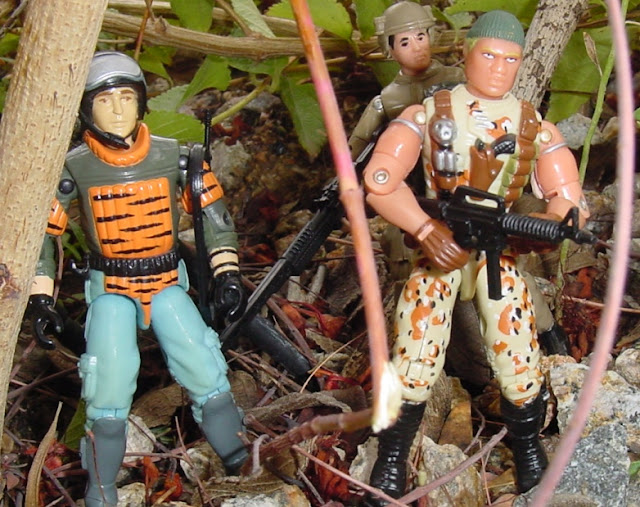
2004 Unproduced Caucasian Desert Patrol Stalker, TRU Exclusive, Midnight Chinese, Sokerk, Argentina, Plastirama, European Exclusive Tiger Force Sneek Peek

2004 Unproduced Caucasian Desert Patrol Stalker, TRU Exclusive, Midnight Chinese,

2004 Unproduced Caucasian Desert Patrol Stalker, TRU Exclusive, Midnight Chinese, Chinese Exclusive Flint, Tiger Force Falcon, Snake Eyes, Tunnel Rat

2004 Unproduced Caucasian Desert Patrol Stalker, TRU Exclusive, Midnight Chinese, Chinese Exclusive Flint, Tiger Force Falcon


2004 Unproduced Caucasian Desert Patrol Stalker, TRU Exclusive, Midnight Chinese,

Wednesday, November 16, 2005

Mestre Rapina - Brazilian Exclusive Voltar

There were roughly 130 unique figures that were released by Estrela in Brazil as part of its Commandos Em Acao line. Some of them were unique amalgamations that combined existing parts to create a new figure or character. Others were simple repaints that brought a different faction or specialty to an existing character. Most, though, were slight repaints of figures that were also released in the US. Most of these featured very subtle color or paint changes that were enough to distinguish the figure from its American counterpart but not make it overtly noticeable. For the most part, this lead to figures who didn't really offer anything much different than what was already available in the US. On occasion, though, Estrela made a slight change that made their version of a figure superior to the American figure. It was not common, but when it happened, American collectors are treated to figures that give new life to some figures that were left to languish in American obscurity. One such case is the Mestre Rapina figure - the Brazilian Voltar.

Technically, Voltar died in the comic when he was trapped in the Cobra freighter. Metaphorically, Voltar was DOA as soon as he was released. The fuchsia base color on the original figure was its first death knell. The biggest problem, though, was that Voltar was redundant the minute they released him. 1988 saw the introduction of the Iron Grenadiers as Destro's new entity. Along with the base troops and a large contingent of vehicles, Hasbro also released a new Destro figure. With Destro as the leader of this new faction, Voltar was relegated to second class status immediately. There was little need for him when you could have a new Destro (whose uniform actually matched those of his troops) leading the Iron Grenadiers into battle. Voltar would probably have worked better as a 1989 release as he would have been a Cobra character to stand out in the sea of '89 army builders and he would have escaped Destro's long, military shadow.

The nice thing about Voltar's obscurity is that he provides modern collectors with a character that they can more easily mold to fit their own Joe worlds. Unlike so many major Cobra characters, Voltar isn't saddled with tons of backstory. Instead, he is a blank slate who has a filecard and a handful of meaningless comic appearances as his only characterization. Like the Overlord figure, Voltar has taken on a second life among collectors. While you don't often see him as a major player, many collectors do attempt to do something with the character. These efforts, though, are usually thwarted by Voltar's terrible color scheme. It's difficult to characterize a new, tough military commander who wears colors close to pink. Fortunately, Mestre Rapina has less of problem in that area than the American Voltar. He is a much deeper color that, while still not militaristic, is closer to something that would command respect. In the final picture of this profile, you can see a comparison of the Mestre Rapina and the American Voltar. You can see how the Brazilian figure is a more subdued purple color that isn't as brazen as the American fuchsia.

Mestre Rapina basically means "Master Robber" or "Master Thief" in Portuguese. If Hasbro called a figure "Master Thief" as a code name, collectors would probably never get tired of ridiculing it. However, when you call a figure Mestre Rapina, it adds a whole new level of mystique to the character. You don't worry as much about how the name translates as the sound of it is exotic and foreign. It adds a level of depth to a figure and character that otherwise would lack anything distinguishing about it. The character, though, is still called Voltar. I do not have a translation of Mestre Rapina's filecard, though, so I'm not sure if they changed his characterization (I would suspect they did, though.) or kept elements of the American filecard. In Brazil, though, The Iron Grenadiers were released as Forca Destro. Members of this included American figures like the '88 Destro and the '88 Iron Grenadier figure. However, Forca Destro also included a V1 Dr. Mindbender, an Astro Viper and Overlord. These additions seemed to take the place of Voltar in Brazil. By the time Mestre Rapina was actually released, the Forca Destro subset had run its course and Mestre Rapina was left as a simple Cobra release.

Mestre Rapina was released around 1993 in Brazil. As he was one of the later releases, it is likely that the Voltar mold is still down there. While many of the molds that are stuck in Brazil are not huge losses to modern collectors, that is not the case with Voltar. Voltar features an interesting mold, a solid characterization and one poorly colored American production release. As such, I think that many collectors would welcome a chance for new, better colored Voltar figure. But, since Voltar did not appear in the 2005 Iron Grenadier themed Convention set, it is probable that we will not see him in ARAH form again.   Mestre Rapina included an interesting complement of accessories. First off, he included a black version of the V1 Countdown's gun. This weapon was also included with the Brazilian Flying Scorpion and is different enough that it works with this figure. The other weapon included with Mestre Rapina is the V1 Alley Viper gun. This is the version with the thin front handle. This is significant, though, as the V1 Alley Viper mold has been MIA since it was intended for use in 1997. The Alley Viper was never released in Brazil, but Mestre Rapina, Albatroz, Letal and maybe a few other Brazilian figures included this weapon. So, was the V1 Alley Viper mold sent to Brazil but never put into production? Or, were just the accessories sent down there? The final accessory for Mestre Rapina is the disk launcher that originally came with the V3 Destro figure. It includes orange disks. Of course, this accessory made it back to the U.S. and was used in 1997. But, the Alley Viper gun that collectors have been clamouring for since the same year has yet to reappear.

In my collection, Mestre Rapina has allowed me to re-examine Voltar. I had no use for the American figure beyond having one for completion's sake. Mestre Rapina, though, offers me a chance to integrate the character into my Joe world. Historically, I have used Destro only has a political player within Cobra. He is not the military commander that he was in the comics. Instead, he takes a role as more of a mentor to the younger Cobras who are trying to swim through the political morass that is the current Cobra administration. Destro does have some military allies, though. Adding Mestre Rapina to the mix has been a good way to slowly give Destro more of a say in military matters within Cobra. While this won't lead to a coup, Destro could ultimately prove the swing vote in any struggle between the current Cobra Commander and the Flying Scorpion character who heads Cobra's South American operations.

Like most of the later Brazilian releases that were slight repaints, Mestre Rapina is not too hard to find. He can be acquired carded or loose from American and Brazilian sellers for well under $15. At this price, he is a bargain. Brazilian figures are always going to be harder to find than their American counterparts and, as the collecting community matures, more collectors will finish up their American collections and start looking to easily acquired foreign figures as the next logical step. Just a few years ago, a figure like Letal could be purchased mint, complete with a filecard for around $15. Now, he sells for nearly 6 times that. While I don't think Mestre Rapina will ever see that kind of increased interest, I do think that it is always wise for collectors to take advantage of foreign figure availability when it appears. Many Brazilian figures that were once common among dealers have started to dry up and have gotten more expensive. As collectors discover that figures like Mestre Rapina are actually upgrades over their American counterparts, I think we'll see some of the more desirable figures slowly disappear. As Mestre Rapina features an improved paint job and better accessories than the American Voltar figure, I think he is a highly worthwhile addition to any collection.

Mestre Rapina, Brazil, Estrela, Voltar, 1988, Iron Grenadier, 2005 Convention Exclusive Destro, Hiss Tank, Track Viper

Mestre Rapina, Brazil, Estrela, Voltar, 1988, Iron Grenadier, Raio Verde, HEAT Viper

Mestre Rapina, Brazil, Estrela, Voltar, 1988, Iron Grenadier

Thursday, November 10, 2005

1993 Mega Marines Mirage

In 2003, collectors were simply sick of Mirage. He had been released 3 times: twice with Vipers that collectors army built to extremes and once with a really crappy hover vehicle. Despite the fact that all three repaints of the mold were well done and were perfect examples of how Hasbro should have approached the retail repaints, the Mirage figures were generally loathed by collectors just because they acquired so many in their army building zeal. A few years removed from this, though, Mirage doesn't have quite the same reputation. Now, he has fallen back into semi-obscurity even though a clear version was released in the Winter Operations set. Collectors have gotten over their overwhelming animosity towards this figure and that has lead me to re-examine his role in my collection. As I finally had a chance to acquire his original version, this visit to the Mirage mold is for the first version of Mirage.

The reality is that this is not the best version of Mirage. In fact, it is only the 4th best version of the figure and that's only because I find it hard to use clear figures. But, as it is the original, it has a significance due to the quality of the mold and the then-unrealized potential of the figure from 1993. The Mirage figure shows a remarkable attention to detail as it features a wide array of molded accouterments that hearken back to the golden years of Joe sculpting. Mirage also features a detailed head mold that is complete with colored goggles that affix to his face. The goggles complement the detailed head gear that is molded onto Mirages head.   The Mega Marines were an interesting subset of figures. They were designed to fight against Cobra genetic "monsters". They all included moldable "bio-armor" that was playdoh that could be stretched over horrid plastic "armor" shells. All the figures in the set were also very bright. They all featured various neon hues of red, yellow, green or blue. The worst part, though, was that they were higher priced at retail due to their included armor. This just added to their pegwarmer status and kept them around gathering dust at retail along with Armor Tech and Shadow Ninja figures.

The figures themselves, though, were actually well done. Each figure had a nicely detailed mold that was just colored wrong. In subsequent years, we have seen repaints of Mirage, Mega Viper, Gung Ho and part of Blast Off. All of these repaints have been light years ahead of the originals and have showcased that these molds can be made into memorable figures with just a sane paint application. I wish Hasbro had taken this approach with more of their ARAH releases. There are still so many well done molds from the line's later years that would be great figures with a decent paint scheme. Instead, they focused on bringing back molds who were done right the first time and revisiting them. In time, this got too repetitive and I think that some of the waning retail interest in the product could be attributed to this lack of ingenuity.

Mirage is an decent figure. In fact, he is about 70% perfect with his base colors of olive and black. Unfortunately, the remaining 30% of the figure was colored bright blue and neon orange. This odd mix of colors doomed the figure. (Though, sadly, Mirage is the best colored of all the Mega Marines figures.) In his time, though, Mirage was somewhat useful. Back in '93, the bar for good Joe figures was actually rather low. While I think that 1993 did produce a wide array of very good figures who stand up against the line as a whole, the sheer number of overall figures produced lead to some real clunkers. These simply overwhelmed the year and left it as being perceived as a terrible year despite the hidden gems. As such, Mirage was one of the more popular Mega Marines figures and did not hang around on the pegs as long as Clutch, Gung Ho or Blast Off.

For years, the Mega Marines were a customizer's favorite. The mix of classic characters, good molds and bad colors lead to many new interpretations of the Mega Marines. Many of these custom pieces showcased the level of detail inherent in all the Mega Marine molds. While more recent years have featured less of this as the part base for customizers has grown and Hasbro has filled many of the character gaps with their vast amount of retail releases, you can still find some customizers who revisit the Mega Marines molds and use their skill to bring out the details that the Hasbro sculptors felt were important but the people who designed the paint masks did not.

While I lament the fact that there weren't more post '00 repaints in the spirit of the '02 Mirages, the sad reality is that collectors really aren't interested in them. One thing I have noted about the Joe collecting community is that we, as a group, do not reward ingenuity and originality in our Joe releases. Since Hasbro brought Joe back in '97, the most popular figures have been the molds of major characters or significant army builders all done in color schemes that are similar to the vintage figure. In the case of a few army builders, collectors have flocked to the newer color schemes, but that was mostly in situations like the Alley Viper where there was no non-neon vintage figure. Yet, even then, collectors lament that the Alley Vipers released were not straight repaints of the V1 figure. Master Collector has been the one outfit that has attempted to create some original figures. Yet, all of their figures with the exception of the Crimson Strike Team have featured waning interest in them after their initial release. It appears to be no coincidence that the lone convention set that has kept collector attention is also the least original in terms of figure mold choice and color scheme. While the Cobra Infantry figures who are slight retools of the vintage mold in almost matching colors are heralded by collectors, a figure like the Nullifier (Who is in the exact colors of the Infantry figures!) who updates a great mold that most collectors don't have in multiples with perfect colors is relatively ignored. It all points to the result that we really only have ourselves to blame for the repetitive releases who feature the same characters, colors and molds over and over again. While this seems to be what the main base of the collecting community has wanted, though, I would suggest that this has been off-putting to the newer, more casual collector and has, over the past half decade, eroded the fan base to the point where they are not a great enough purchasing entity to keep the line afloat at retail.

I have yet to really determine this Mirage's role in my collection. While I use the later Mirage repaints as faceless army builders, that was more due to the fact that I had amassed them in quantity and liked the mold and color schemes so much that I wanted to use more than one of the figures at a time. This version, though, is more unique and really needs to be used as the character of Mirage. While Mirage was intended as a heavy gunner, but I can not see him in that role. I think of him more as a technological foil to Zartan: someone who uses new technologies to hide in plain sight and mimic invisibility as a means of infiltration into enemy territory. Going forward, I may flesh the Mirage character out a bit more. But, for now, he remains one of those figures who doesn't see a lot of use but does get pulled out of his drawer when I stumble across him in a search for another '93 figure.

Mint and complete Mirages are actually somewhat hard to find. The Mega Marines was an unpopular, higher priced subset at the end of the line that was still hanging around retail in 1995. As such, many collectors passed these figures by. With the majority of them going to kids, many Mirages were played with, damaged and suffered lost accessories. Now, a complete with filecard Mirage typically will run you around $11 or so. Some will be more expensive and others can be cheaper. It seems this is one case where overused repaints of the mold actually helped the original release as collectors realized that it was a quality mold and discovered (as they tried to find one) that the original figure is actually tougher to find. Now that there are better versions of the figure available, I find my need for the original Mirage to be diminished. This version is still rather visually interesting, though, and could find a place in various base situations. But, if he's going into the field, this version is put away and some of the 2002 figures will come out. Most collectors are the same way and, these days, you will not often see this version of Mirage being desired for anything more than completion's sake.

1993 Mirage, Mega Marines, Monster Blaster APC, Blast Off, Clutch, Gung Ho, 1992 Flak Viper, 2004 Urban Assault Nullifier, Barricade

1993 Mirage, Mega Marines, Cyber Viper, Create a Cobra Mail Away

Wednesday, November 2, 2005

2005 Comic Pack Rock and Roll

In 2004, Hasbro announced they were producing 3 figure packs that were based on issues of the classic Joe comic. When the first pictures of these surfaced, collectors were quite pleased with the results. At the '04 convention, more figures were shown and collectors were even more excited over the possibilities that were shown. Now, over a year later, all of those figures have been released and we are afforded the luxury of hindsight to see how the line fared. While the comic packs gave collectors some of their most requested characters, they also suffered from repetitiveness and many poor mold choices. As such, I would rate the entire exercise as mediocre. It was a great idea. The execution lacked the direction, though, to produce a line that was truly memorable. One figure who perfectly personified my opinions of the packs as a whole is Rock and Roll.

Rock and Roll was released in the 3rd series of comic packs. He was included in #8 along with Short Fuze and an astronaut Flash. His series, though, also featured packs 6 and 7 which included the fan favorite and highly anticipated Oktober Guard figures. Naturally, this put Rock and Roll's pack in an immediate bad spot as he was doomed to be a member of the least popular pack in his wave. It's not entirely justified, but the inclusion of 5 new Oktober Guard figures were simply so desired that Rock and Roll's pack was not fairly judged from the beginning.

Rock and Roll was the Joe team's original machine gunner. He was actually graced with a unique chest mold on his original figure in 1982. (This mold was later exported to Argentina, Brazil and Mexico. The mold was also used in Argentina as part of the Shimik figure. It is likely that this mold died in South America as Rock and Roll was missing from the 1997 Stars and Stripes set even though the back of the package showed that he was intended as a member.) While this updated figure is an homage to the original design, the longer hair and full beard actually looks a bit dated. While that isn't too bad for a figure intended to be a throwback, it does somewhat limit his appeal to newer collectors.

On the surface, this figure is actually quite good. Where most of the comic pack figures failed was that they went sequentially from the first issue of the original comic and used many original molds from the '82 series. While these molds are historically significant, the fact is that they are very dated: even when compared to figures released only a few years after them. This lead to a great deal of repetitiveness in the line as Hawk, Stalker, Zap, Stalker again and Breaker all used the same body in the same basic colors. Where Hasbro broke this trend, though, they actually got rather creative. Clutch, Steeler, General Flagg, Grunt and Rock and Roll all used different, more modern parts to create figures that better fit within the context of the Joe line as a whole but were limited by the fact that, again, they were in the same basic colors as the other figures who used older molds. The fact that the use of the Big Ben body for Rock and Roll actually is in line with the characters original appearance showed a level of planning that has been missing from most of the ARAH style Joe releases. But, even this had a flaw.

While Rock and Roll's colors and body mold are a perfect update to the original figure, the sad part is that the mold choice was already too common for it to have the necessary impact. Aside from the fact that Rock and Roll used the same General Tomahawk legs as most of the other comic pack figures, the Big Ben torso mold has been released 3 times since 2001. One was a huge pegwarmer and the other two were included with highly collectible army builders. As such, many collectors have grown tired of the Big Ben mold and have little love for the character. On top of that, the Schrange figure who was released the same time as Rock and Roll in comic pack 6 used the same chest. While it was differently colored, it still was a glaring misuse of parts in too close of proximity to each other. This left Rock and Roll feeling like he was less original and just more of the same, tired figures Hasbro had released since 1997.   The bright spot of the Rock and Roll figure, though, was the newly sculpted M-60 machine gun and bipod. This new weapon was slightly shorter than the original sculpt M-60 but has more bulk. It fits with the scale of the figure perfectly. It is highly detailed and is probably one of the best new sculpt weapons to appear in the comic packs. It is of high enough quality that it simply must be re-used more in the line. Figures like the SAW Viper, Roadblock, Vietnam Snake Eyes and even another Rock and Roll would be perfect candidates for this weapon. While I don't want to see it released with every figure, it would be a better choice for many potential characters as the line moves forward.

For some reason, Rock and Roll never really played a big part in my collection. As a kid, he was one of the last original figures I acquired. By the time he was added to my collection, Roadblock had already come along and replaced much of the need for Rock and Roll. When the second version of Rock and Roll was released in 1989, I was pretty much out of Joe. I still collected the comic, though, and saw Rock and Roll's appearances there in his new uniform. This fascinated me as I thought the design was just a great update for the character. When I returned to collecting in the '90's, a complete '89 Rock and Roll was one of my first priorities. But, after I got one, it still didn't bring the character into my Joe world on a full time basis. I never really felt that Rock and Roll distinguished himself enough from the original Joes. As such, I never took to the character in a way that would keep him a major player in my collection. With the advent of this figure, though, I can see some of that changing. While the comic pack figures as a whole have been repetitive and dull, some of the remakes have moved into my top tier rotation. As I have enough diversity of color and mold in the figures I use the most, I can absorb a comic figures or two (Clutch being the other who has become important) as they are different enough from the other figures that their mundane colors aren't overused. As Roadblock has fallen a bit in my collection due to the incredible over saturation of his molds, Rock and Roll is poised for a bit of a comeback. This figure is just interesting enough that it could be a welcome addition to my most used Joes.

Overall, I think the comic packs have been a modest success. When taken as a whole, they have more good figures than the TRU exclusive sets have offered, but still have too many misses for them to be considered great. Only now that Hasbro has freed themselves of the constraint of moving chronologically though the comics has some diversity creeped into the releases. The last two waves of comic packs showcased a panorama of new colors that added some much needed life into a medium that was all too green and drab. (Unfortunately, they took a step backwards by releasing Comic Pack #9 as it was just more of the same and wasted a valuable slot by producing a crappy DD comic pack. It should have been scrapped and Cover Girl released on a single card as she is the only figure in the pack that anyone wants or cares about.) My feeling on the comic packs from the beginning was that they were too similar to really take off at retail. And while sales seem to have been decent enough at first, the reality is that the line was heavily clearanced after Christmas of 2004, the Rock and Roll wave of comic packs saw shortened production, the wave succeeding Rock and Roll's was heavily clearanced and unsold Wave 1 comic packs showed up at discount retailers in bulk for 1/2 the retail price. This is not the hallmark of a strong line. I think that had Hasbro skipped around from the beginning and offered a wide selection of figures and characters in each and every wave, it might have been more successful. Parents had little incentive to buy each pack as, from their perspective, the figures in each pack were largely the same. Had their been comics from different eras in each wave, there might have been greater interest among kids and their parents as they would have felt they were getting something different and new with each pack. At this point, though, that's moot anyways.

Right now, this Rock and Roll is somewhat hard to find. He was released during a slow retail period and his entire series of comic packs actually saw a shorter production run than the other waves. As such, going forward, this will be a figure who will be more difficult to find than the other comic pack figures. This isn't to say, though, that he's rare. Most collectors had sufficient opportunities to acquire this figure at retail and were able to do so during his short release window. Some people are currently paying astronomical prices for carded samples of comic packs 6,7 and 8. This is premature as it is still not certain that all overstock has made its way to discount retailers. Plus, the fact that collector demand was mostly sated for this figure and he isn't a sculpt that will have a huge demand for it going forward helps ensure that even the reduced availability won't translate into a high future price tag. I think this figure was a good buy when purchased at retail. He is a more traditional version of Rock and Roll that actually fits in with later figures. That's nice, but he will never be the type of figure who becomes a fan favorite.

2005 Comic Pack Rock and Roll, Stalker, VAMP, TRU Exclusive, Chief Torpedo, 2004

2005 Comic Pack Rock and Roll, Stalker, VAMP, TRU Exclusive, Chief Torpedo, 2004

2005 Comic Pack Rock and Roll, Stalker, VAMP, TRU Exclusive, Chief Torpedo, 2004

2005 Comic Pack Rock and Roll, Stalker, VAMP, TRU Exclusive, Chief Torpedo, 2004, Bullhorn

2005 Comic Pack Rock and Roll, Stalker, Classified, Snake Eues, Chief Torpedo