Thursday, September 28, 2017

1991 Tracker - Around the Web

Tracker is one of those figures who foretold the neon that was to come in 1992 through 1994.  The figure's mold is solid.  But, the coloring just makes no sense whatsoever.  I've always wanted to like the figure.  But, I've never been able to since his red and yellow combo is tough to use.  But, the figure has potential that Hasbro never realized.  Here's the best of Tracker from around the web.

Tracker Profile

Tracker at JoeADay.com

Tracker at 3DJoes.com

Tracker Dio 1

Tracker at Half The Battle

Tracker Dio 2

Tracker Dio 3

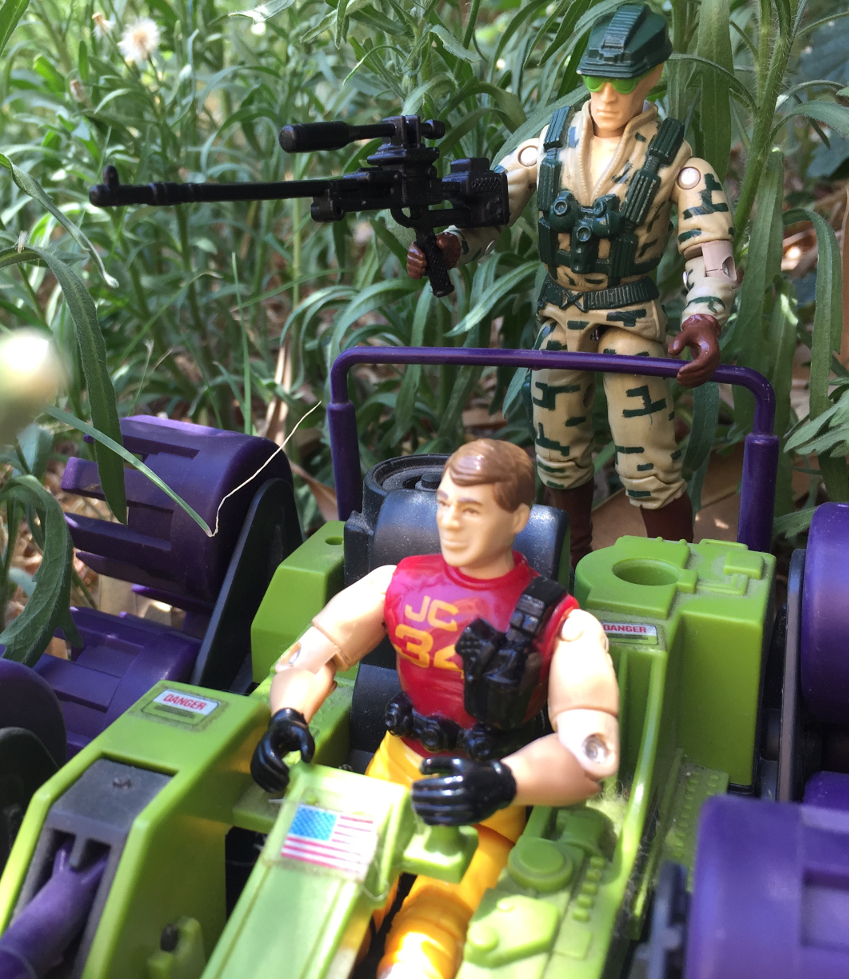
1991 Tracker, Ozone, Eco Warriors, Low Light, Mercer

1991 Tracker, BAT, Battle Android Trooper, Funskool Red Dog, 2001


Tuesday, September 26, 2017

2002 Alley Viper

If you were a G.I. Joe collector in 2002, you know how army building crazy the community was.  Starting in 2001, Joe collectors were simply starving for any retail army builders.  Figures that weren't great would get purchased in bulk just because collectors wanted to army build something.  It was an almost unhealthy obsession.  But, Hasbro of the time did us no favors.  The army builders of 2001 were not great and were often packed with lackluster Cobra character repaints.  No one wanted 20 Major Bludds, Destros or terrible Zartans.  They wanted Vipers, Bats and Troopers.  But, for some reason, Hasbro was loathe to release any of those collector demanded entities.

In late 2001, Hasbro released the prototypes of the New Sculpt Joes that would debut in 2002.  Collectors immediately hated them.  The odd proportions and lack of o-ring doomed them to obscurity.  Hasbro, somehow surprised by the backlash, quickly went back to the drawing board to retro fit later new sculpt molds to include the o-ring.  But, doing so delayed their release.  Hasbro needed something to fill the retail void since Joes were actually decent selling toys back then.  They also actually wanted to do something for collectors to appease them and give the new line a chance later.  So, Hasbro came up with Wave 1.5.  It was a set of 4 vintage Joe packs that were meant to bring some fan favorite molds to production.  The set included General Tomahawk/Headman, Sure Fire/Slice, Mirage/Cobra Viper and Big Ben/Alley Viper.  Sure Fire and General Tomahawk were meant to the be the 1988 Shockwave and 1986 Hawk as a favor to fans who cherished those molds.  But, the tooling was not found and later, less popular molds were used.  The Viper and Alley Viper, though, were Hasbro's way of giving collectors army builders to amass in unforetold numbers.  And, despite their insistence at packing the army builders with Joe characters, it worked.

Collectors immediately went bananas over the retail army builders: buying them in droves and clearing out any retailer who had ample stock.  (The first shipments appeared at Wal Mart and they stocked several cases at once.  My local store had so many that there were boxes stacked on the tops of the shelves and half opened boxes on the lower shelves in addition to the full pegs.)  Collectors quickly posted photos of 10, 20, 50, even 100 Alley Viper and Vipers to showcase their support for these figures.  One thing the army building craze did, though, was obscure the fact that not all the army building figures of the era were winners.  Starved collectors would buy multiples of any figure with "Viper" as part of the name.  So, it was difficult to tell the stinkers from the gems since everything disappeared quickly.  In the 15 years since this time, though, winners and losers have appeared.  The green Viper from this wave is relatively forgotten and unloved.  His Alley Viper companion release, though, has found greater popularity and remained a stalwart of many Cobra armies.

The reason for this is that the figure is well done.  While the parts aren't ideal and remain a source of ire to this day, the overall body design isn't terrible.  It's better than the kit bash Hasbro concocted for the Viper, though not by much.  The colors are subtle.  The base blue is a bit light for classic Cobra.  But, it's also OK.  It fits with many Cobras of the era and even earlier without being too derivative.  The grey, white, black and silver details are subdued and give the figure texture without taking away too much from the base color.  In short, this is a good, solid Cobra who works with established Cobra colors.  His gear is pretty much great since you get the face shield (which is less prone to breakage with the softer plastic of the 2000's), a good enough Big Bear backpack and the Cobra hand held shield.  The weapon choice is bad, though, since he includes a Tomax/Xamot pistol instead of the AK-47 that was so common at the time.  Fortunately, it was easy to get better accessories for these figures from the superfluous overstock of figures who were packed with army builders.

Wave 1.5 is one of the most overproduced waves in the post vintage history of the line.  When the wave first appeared, it showed up en masse at retailers around the U.S.  There was regional lag and any collector who was plugged into the community was quickly able to find the wave as it appeared.  But, then, it continued appearing.  As the summer moved on, retailers stocked more and more of the wave.  It sold well enough since collectors loved the Viper and Alley Viper.  But, it kept coming.  In the fall, bonus packs of the figures began to show up at K Mart.  They included one of the 2 packs from the wave along with a third, bonus figure: also from the wave.  Then, the wave began to show up at discount and other non-traditional retail outlets.  Into 2003, the Wave continued to appear at odd places.  A large volume of the cases were actually shipped to Israel for pennies on the dollar and Israeli toy dealers were able to sell some figures to Americans for cheaper than they could buy the figures at retail.  Into 2004, the wave continued to ship to places like Dollar General Stores: who had to discount the two packs to $1 each to move them.  There was just so much of the product that Hasbro struggled to get rid of it.  And, as the Joe line was dying out in that retail incarnation, the wave became a bit of a target for collector frustrations since it was so overproduced and collectors were drowning in oceans of Big Ben and Mirage figures.

This configuration of the Alley Viper first appeared in 1997.  In 2002, this blue version was released and, later in the year, a red repaint was packed one per case.  In 2003, the mold was colored in brighter blue and released with a repainted Viper in the infamous wave 7.75 "Army Builder Wave" that came and went from retail in the blur that was G.I. Joe sales in the 2nd half of 2003.  The figure was planned as part of a Wal Mart exclusive Sky Patrol themed set for late 2003 but the entire concept was cancelled.  The unproduced figures are relatively available, though, as tons of stock were sold by Asian Joe sellers.  The final appearance of the figure was the all black version in the 2004 Toys R Us exclusive Urban Strike set.  The mold never appeared again.  However, collectors had gotten a bit burned out by so many releases of the Alley Viper in short succession.  So, his absence after 2004 was never really an issue: especially since pretty much all 5 of the paint jobs for this parts combo are well done and generally liked by collectors.

This version of the Alley Viper, despite his availability, has actually maintained some value in the past 15 years.  Mint and complete figures generally sell in the $8 range.  You can get carded versions for $11 or so, showing how worthless the Big Ben figure in the 2-pack really is.  Dealers will sometimes price him in the $15 - $20 range and sell a couple, too.  But, $8 is more common and a little patience will yield you a figure at that price.  But, getting an army of these guys will take some time.  They are not nearly as available as you would think.  It seems that many collectors who built armies of this figure have kept them and are not into liquidating their excess versions.  But, when you look at the combination of mold quality, figure colors, included accessories and general availability, you can see why this figure has become one of the more sought after army builders of the era.

When I liquidated the majority of my collection, this version of the Alley Viper stayed.  I had a few of them.  But, I also had armies of several other versions of the character.  I consider the 1997 version the best and kept all of those.  But, I also held on to this version.  Part of that is because of the time in which I sold my collection.  Back then, this figure was still relatively worthless.  And, I didn't feel the paltry sum of money I'd get for them would be enough to offset their quality.  The other part, though, is that I just kind of like this figure.  He's a neat design and decently colored.  In 2002, I had more of him than any other Alley Viper so he was my default version.  That nostalgia helped him, too.  Now, I'm happy to have retained these figures. They are a nice way to use the Alley Viper character and give me another option from the 1997 releases.

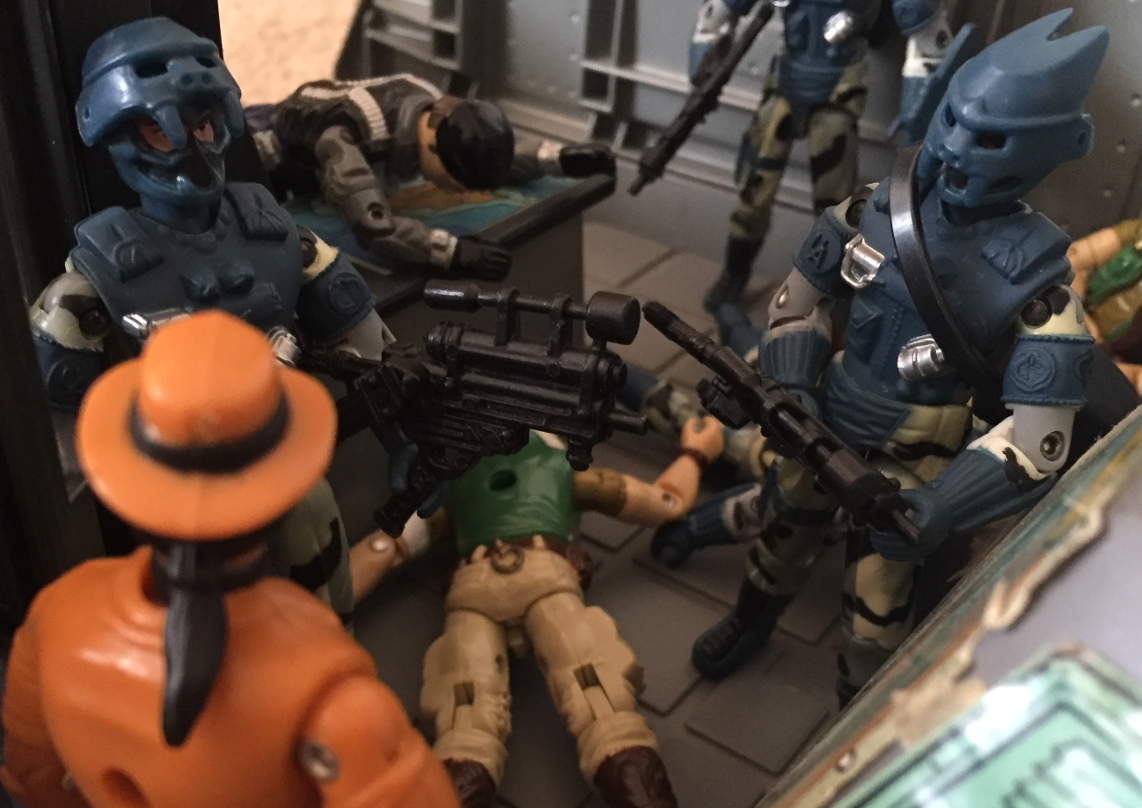
2002 Alley Viper, Headman, 1990 Law, Dialtone, Super Sonic Fighters

2002 Alley Viper, Headman, 1990 Law, Dialtone, Super Sonic Fighters

Saturday, September 23, 2017

G.I. Joe #30 - Marvel Comics

I bought my first Joe comic at a drug store in June of 1984.  I immediately sent away for a yearly subscription to the book.  My first issue received through the mail, #29, arrived in August of 1984, a few days after it had shown up on the comic rack at said drug store.  As September arrived, school started again.  I hadn't seen much of my friends that summer as we lived fairly far from my school and pretty far away (in kid terms) from any of the kids in my class.  So, it was great to be back in class and have recess and down time to discuss the latest Joe comics with friends: both good and casual.  The first comic to arrive for that school year was #30: Darkness.

Darkness starts with the cover of the Dreadnok Buzzer slicing the tail off of a Skystriker while Ripper and Torch do additional damage on the ground.  It's a striking cover, full of action.  And, it shows the bad guys actually "winning" in that they are destroying the good guys' equipment with no Joes in sight.  The story inside actually pertained to the cover, too.  As a kid, it annoyed me when the cover was a tease and unrelated to the events of the comic behind it.  So, it was cool to see the Dreadnoks in action inside.  (The beat up version you see if my original copy I got in the mail back in 1984.  It hadd a good life.)

G.I. Joe #30, Dreadnoks, Marvel Comics, 1980s


The basic plot is that Zartan and the Dreadnoks convince Cobra Commander that the secret Joe base is on McGuire Air Force Base.  Learning his lesson from the failed frontal attack in G.I. Joe #19, the Commander opts for a small strike force to carry out a sneak attack.  The premise is rather weak, but it helps contain the action.  The memorable item from the early pages is Zartan turning himself into Hawk and interacting with the Joes.  The scene was somewhat recreated in a convention exclusive 3-pack of figures in 2004.  It was an imperfect homage.  But, those figures were meant to invoke this early use of Zartan's disguise capabilities.

G.I. Joe #30, Dreadnoks, Marvel Comics, 1980s


There's a couple of things of note in this issue.  First and foremost was the introduction of the Hiss Driver.  For some reason, the comic never showcased the unique driver of Cobra's iconic tank: despite the fact it had been in the comic for year at this point in 1984.  And, they weren't Hiss Drivers.  Instead, they piloted the SNAP helicopters.  The SNAP choppers are actually FANGs.  This, again, is odd since the FANG had appeared in lots of issues on the comic in the previous 18 months and there was really no reason for them to get the vernacular wrong.  But, here you have Hiss Drivers flying misnamed helicopters.  Nothing is more Cobra than that.

G.I. Joe #30, Dreadnoks, Marvel Comics, 1980s

Billy also makes an appearance in this issue.  He is caught by Major Bludd and the Baroness as he rifles through Cobra records.  This begins the Billy assassination attempt on Cobra Commander plotline that would culminate a couple of months later with the revelation that Cobra Commander is Billy's father.  As a kid, I didn't much care for the Billy storyline.  While I liked some of the intrigue within Cobra, I didn't care for the Billy character.  In G.I. Joe #10, he worked as a plot device.  But, I'd have much rather that Kwinn or Dr. Venom had survived into the later issues rather than Billy.

Of course, the Dreadnoks muck up the attack by alerting the authorities after they destroy a Skystriker.  This brings the Joes running and they quickly defeat the small Cobra force.  Cobra Commander returns to lick his wounds and the story deverts back to Snake Eyes for the next couple of issues.  One point that sticks with me, though, is how well the story between the early comics moved along.  There were elements of the issue that would come back later and loose threads from prior (and later) issues would come together as the year ended.  This was why I found G.I. Joe such compelling reading.  There was always an open plot to get you to come back.

No look at a comic from 1984 would be complete without the ads.  The most notable entry in this issue was a full two page spread from NBC showcasing their Saturday morning lineup that would have started airing the month this comic was released.  You see the classics such as Smurfs, Alvin and the Chipmunks and the Amazing Spider Man.  But, there are also completely forgotten shows like Kidd Video, Pink Panther and Sons and Going Bananas.  As a kid, I'd flip between the three channels on Saturday morning to find the shows I liked.  I watched some Mr. T, Alvin and the Chipmunks and Spider Man and His Amazing Friends.  The notion of a kid friendly cartoon lineup being a weekly event is so antiquated that my kids can't even understand the concept that we didn't really have a way to watch a show whenever we wanted.  It's completely foreign to them to not have whatever entertainment they want at their fingertips.

G.I. Joe #30, Dreadnoks, Marvel Comics, 1980s


Like pretty much all comics released by major publishers in the 1980's, G.I. Joe #30 is worthless.  You can get a mint copy for a couple of bucks.  The issue was reprinted through the years and you can find those with relative ease for even cheaper.  It's too bad that Hasbro never looked at this issue for a comic pack.  While it would have been a way to get the Dreadnoks out (they appeared with a later issue comic) it would have also been a good way to release an updated Hiss Driver (whose mold they had at the time) or another Joe character.  I'd have preferred either of these offerings to the Thrasher figure that was included in the later pack.

This issue really is the harbinger of the year to come for me.  As I was back in school, all the events of the comic were points of discussion and the basis for many Joe adventures.  The fall of 1984 was an awesome Joe time as some new kids had just moved in down the block and I had someone nearby to play with every day.  It was through them that I first saw the Dreadnoks in December of that year and was blown away by the amazing offerings coming in 1985.  The Joe mini series cartoon aired this month and introduced Shipwreck, Lady Jaye and Flint, too.  So, while I was enjoying Stormshadow, the Whale and even new Dreadnoks, I had great anticipation for what 1985 would bring.

I've completely lost that season wonder as an adult.  Now, I'm happy when school starts since it's a much easier routine with my boys.  But, the fall and holidays bring work and planning instead of overwhelming anticipation.  I don't see a unifying set of toys that resonate with kids today.  Even among my three boys, each has a specific toy interest that bears little in common with their brothers.  The idea of a one or two toy lines dominating a generation is pretty much gone.  In some ways, that's too bad since you could pretty much bond with any kid over Joe or Transformers in 1984.  But, my kids are also exposed to a much broader array of items and have a greater spectrum of toys than I ever did.

Thursday, September 21, 2017

1985 Tomax and Xamot - Around the Web

Tomax and Xamot have long been among the most popular Joe figures.  Usually, they are among my most popular posts and they remain a staple of most people's collections.  The figs are odd.  But, that weirdness makes them iconic.  There are no figures who could get away with their look and the circus-y outfits work with the twins' characters.  As they are popular, there's lots of content out there.  Here's the best of the 1985 Tomax and Xamot from around the web.

Tomax and Xamot Profile

Tomax and Xamot Pre-Production at YoJoe.com

Tomax and Xamot at JoeADay.com

Tomax and Xamot Video Review

Tomax and Xamot Dio

Tomax and Xamot at 3DJoes.com

Tomax and Xamot Video Review 2

Tomax and Xamot Dio


Tuesday, September 19, 2017

1984 Sky Hawk - Mail Away Version

As a kid, the Skyhawk didn't, initially, click with me.  My younger brother acquired one in the latter half of 1984 and the toy simply didn't seem all the interesting to me.  I had a Skystriker that was still in decent enough shape.  And, the Dragonfly was still going strong.  On the Cobra side, though, I had few, if any aircraft.  So, my play pretty much all centered around ground and naval adventures.  Aircraft simply didn't see a lot of time.  Slowly, my brother broke his Skyhawk apart and it was relegated to the junk box in our toy room.  In late 1986, though, this changed.  First, my youngest brother acquired the magnificent Cobra Night Raven.  While the plane was awesome, it was also overly large.  But, the drone that attached to the back was the perfect size for what I wanted from a Cobra aircraft.  This weapon gave Cobra air superiority.  Around the same time, though, my younger brother also acquired the Sears Dreadnok Air Assault set that included a repainted Skyhawk.

I was never big on Joe vehicles becoming Cobra.  I liked each group to have its own equipment.  So, the Dreadnok Skyhawk was quickly requisitioned to Joe and became my default Joe aircraft.  It was the perfect size to battle drones.  In early 1987, I was given a new, original, Skyhawk when I acquired a collection from the kids down the street.  This joined my Dreadnok version and the Skyhawks became more specialized: the Dreadnok version was the aquatic version while the original was the "land" version of the vehicle.

For the remainder of my childhood play, the Skyhawk's dominated my aerial combat missions.  Usually, they were piloted by my Silver Pads Grand Slam who wore a Lifeline Airmask.  The pilot and vehicle were army builders and would routinely be shot down by Cobra's top notch Strato Vipers behind the helm of a drone.  (In my final days of play in late 1987, the Mamba drones joined with the Night Raven drones against the Joes.  The Mamba drones had better weapons.  And, there were two of them!)  There were dogfights, undersea rescues of a downed pilot and horrible crashes that resulted in long term plot devices.  In short, the Skyhawks were integral to my final years' Joe experience.  Of course, this resulted in both version of the Skyhawk taking a beating.  I put them away with the rest of my Joe toys in early 1988.  But, as both aircraft had been integral to my adventures, I often found my youngest brother would take them from my storage place and play with them.  The result was two battered toys.

In the late 1990's, when I started to rebuild my Joe collection, I found the old Skyhawks.  But, the old designs didn't hold as much sway as they had used to.  By that time, I owned a Razorblade helicopter and it more adequately filled the role of small Joe attack aircraft that I wanted.  But, the dilapidated condition of the original Skyhawks was bothersome to me.  So, they were just left in boxes and didn't really matter much, anymore. The husks of the vehicles were moved around and, eventually, parted out to other collectors.

I paid the Skyhawk little attention until the spring of 1999 when it became known that Hasbro Canada still had a massive amount of overstock Joe mail away toys from the early 1990's.  Among the items you could purchase were both the Cobra Firebat and the Skyhawk.  For a couple of bucks each, I couldn't pass these items by.  I ordered only around 20 or so figures from the find.  But, I picked up two each of the Firebat and Skyhawk.  Upon receiving them, it was obvious that the Firebat was the brighter, mail away version.  When I looked at the Skyhawk, it appeared it was also the mail away version.  But, I paid this little mind.  I had a new Skyhawk and it took a place of prominence in my collection.

In the summer of 2000, I stumbled into one of those deals that every collector tells you about but never seems to happen to you.  A guy posted to the Joe Usenet newsgroup that he had a collection he wanted to get rid of.  I was the first to respond.  He said to send him my address and, once I got the toys, simply reimburse him for shipping.  I figured it was no risk and I'd get a few, beat up items.  About a week later, I came home to three huge boxes that were blocking my front door.  Upon opening them, I found nearly an entire collection of 1983 to 1985 figures and vehicles, mostly in mint condition.  I quickly wrote a check for $40 to cover the shipping, thanked the former owner and marveled in the fact that my collection had exploded.  I hadn't been too keen on vehicles since I had been living in apartments and moving frequently at the time.  But, this new collection coincided with the fact I had recently purchased my first home and had some room to store and display toys.  As I took all the goodies out, I found a mint and complete Skyhawk.  I set it up on a shelf next to the one from Hasbro Canada and, for the first time, noticed the stark differences between the retail and mail away versions of the vehicle.

The mail away Skyhawk is a much richer and deeper green color.  The retail version is more olive drab.  In terms of realism, the original is probably more in line with the traditional military colors of the early Joe vehicles.  But, the darker green of the mail away is much more visually pleasing to me.  I'm a sucker for the color I call "Brazilian Green".  It's a dark, vibrant green color that appears on the accessories included with many Joes from the Brazilian Comandos Em Acao line from Brazil.  Estrela used the color on pretty much every green accessory they released.  And, as this mail away Skyhawk was made in Brazil, too, it features the dark green color that I so enjoy.

Aside form the color, the black missiles, engines and skids are a slightly different shade of charcoal and appear slightly more glossy than the American, retail versions.  The other main difference is that the Hasbro copyright markings on the inside of the cockpit have been removed.  (See the photos below for details.)  Estrela did this on most of the early releases.  The first waves of figures made in Brazil had the production stamps altered to reflect the toys were made in Brazil.  As the line wore on, this was less common.  I'm not sure why they would do this.  But, Funskool in India altered molds similarly, all they way through their final figure releases.

As a toy, the Skyhawk isn't bad.  It's not very large and holds just one figure in the cockpit.  Even some 1984 figures are too large to fit in there, though.  You can place two figures on the skids.  It's a decent feature that was kind of fun as a kid.  But, the practicality of such a feature is rather ludicrous.  The aircraft features two missiles and a swiveling chin gun.  It's a nice amount of armament for a vehicle this size.  There are also two smaller cannons molded into the sides of the vehicle.  As a kid, these were incendiary rounds that would turn a Cobra drone into a fireball instead of a dying bird as it fell from the sky.  For Cobras who wore parachutes, the fireball was a psychological deterrent.  Outside of that, the removable wings give the toy some visual appeal.  But, they also cause a great many wings to be missing from wild Skyhawks.  In short, it's a great, low price point vehicle from a time when Hasbro really tried to have toys available for every budget.

Original Sky Hawks are easy to find and relatively cheap.  You can get mint and complete versions of them for around $11.00.  Dealers, though, will often ask for at least $25 and sometimes even more.  The mail away version, though, is much harder to find.  Properly labeled, the mail away versions will sell in the $40 range.  But, as many collectors won't recognize the color differences, you can find mislabeled mail away Sky Hawks with a little looking and get them for a bargain.  You see collector interest in mail away vehicles wax and wane over the years.  And, something that's really hard to find and expensive today may drop in price and be relatively easy to find tomorrow.  The huge amount of mail away Skyhawks released into the collecting community through the Hasbro Canada find helps to sate demand and has made this variant much easier to find that if they were only available through those who acquired one as kids.

For me, either version works just fine.  If I hadn't gotten the mail away version in the manner that I did, it's doubtful I'd have tracked one down.  But, as a visual distraction, the mail away version is nice.  I used it with my foreign figures quite often: just for something a little different than you average Joe diorama.  Individual collector value will vary in regards to these items.  If you just want a Skyhawk as a toy, buy the retail version and save money.  But, since you can still find the mail aways from time to time, they are just as good.  The quality is there and the colors are just different enough to be fun.  I've found that the Skyhawk mold is still an excellent complement to the figures from the line's early years.  Now, that's where they see the most use.  It's a far cry from their days as my de facto aircraft.  But, the fact that this mold remains relevant to me after more than 30 years is a testament to it's overall quality.

1984 Skyhawk, Mail Away, Starduster, 1987, Grand Slam, Silver Pads, TNT, Fuego, Argentina, Plastirama, Ripcord


1984 Skyhawk, Mail Away, Estrela, Brazil, Blades, Sokerk, Quarrel, Silver Pads Grand Slam, Palitoy, Action Force, Plastirama, Argentina

1984 Skyhawk, Mail Away, Estrela, Brazil, Blades, Sokerk, Quarrel, Silver Pads Grand Slam, Palitoy, Action Force, Plastirama, Argentina

1984 Skyhawk, Mail Away, Estrela, Brazil, Blades, Sokerk, Quarrel, Silver Pads Grand Slam, Palitoy, Action Force, Plastirama, Argentina

1984 Skyhawk, Mail Away, Estrela, Brazil, Blades, Sokerk, Quarrel, Silver Pads Grand Slam, Palitoy, Action Force, Plastirama, Argentina