Friday, August 11, 2017

1995 Dr. Mindbender Concept Art

As part of the ill conceived "HasCon", Hasbro released this spectacular 1995 Dr. Mindbender Battle Corps Rangers artwork.  It is, to my knowledge, the debut of what would have been this figure's card artwork.  It has taken nearly 25 years for this artwork to come out and it's rather disingenuous of Hasbro to have held it back for a self serving convention that doesn't cater to Joe fans rather than showcase it at any of the 15 Joe conventions that have been held: many encompassing major milestone anniversaries of the brand.  That aside, though, we finally have a glimpse into what this character may have looked like on retail shevles.

From the hand painted sample of this figure that exists, we knew that the figure would be mostly purple and black.  So, the colors aren't really a surprise.  But, there are a few elements to the figure that do stand out.  The most obvious is the black version of the 1992 Wet Suit's rifle.  This is a terrible weapon and would have been a huge disappointment for this figure.  It's an odd choice for sure.  I'll discuss that more later on, though.

The next interesting part is Mindbender's hand.  In the unpainted prototype, the hand appeared to be a monstrous deformity.  On the painted figure, the hand was just purple.  Initially, I could have seen this just being a cost saving measure.  However, the artwork shows that the hand is actually a glove and the razor sharp fingernails are metal weapons built into the fingertips.  On the one hand, this is kind of a cool.  But, on the other hand, it takes away from the monster aspect of Dr. Mindbender.  The unpainted piece always conjured up a ghoulish image of a broken Dr. who was the victim of his own mad experiments.  This artwork, instead, shows a man wearing armor to enhance his fighting prowess.  It's a drastic departure from my ill formed, preconceived notions for the figure.  So, I feel that it's destroying 20 years' worth of my imagination of what this figure would have been.

The final aspect of the art that is great is that we can see Mindbender with his helmet on.  The unpainted prototype has the helmet.  But, the hoses were hard resin, despite the fact that there were holes in the back of the helmet which appeared to be for the hose ends.  This art shows that the figure was likely to have had hoses that did attach into the helmet.  It's possible they would have separate pieces.  Or, the entire helmet may have been planned to be flexible plastic like the mask on the 1994 Shipwreck.  Either way, it could have worked.

Coming back to the gun...I wonder if this Dr. Mindbender was supposed to be a diver.  My first inclination is definitely not.  He doesn't have flippers and any diver would be drawn with those.  But, the Wet Suit gun gives me pause.  and, this artwork clearly shows the mandible like helmet, much more clearly.  This is interesting because of the bug like figure that appears on the 1995 Tactical Battle Platform artwork.  As this figure is attacking the TTBP, it's obvious he is a Cobra.  He is also wielding the Wet Suit gun.  The character's head, though, is looking up with pincers.  In looking more closely at this Mindbender, it appears this is very likely meant to be Dr. Mindbender crawling out of the deep the attack the Joes.  Plus, the helmet with the hoses looks like it could be underwater breathing gear.

Now, I have no idea why Hasbro would make Dr. Mindbender (of all people!) a diver.  It is possible.  The prototype Dr. Mindbender appears to have a webbed left hand.  However, this detail is missing in the artwork.  At any rate, it makes me that much more interested to read this figure's planned filecard to see what Hasbro intended for him.

1995 Dr. Mindbender, Unproduced, Battle Corps Rangers

Thursday, August 10, 2017

1988 Hardball - Around the Web

In 1988, I bought Hardball due to his baseball connection.  In a weird bit of kismet, the day that JoeADay.com showcased the figure, Matt Cain of the Giants threw a perfect game.  I attended my first Cubs game on August 5, 1988.  It was the first of a four game series against the Phillies that would culminate in the first night game in Wrigley Field history.  So, I'm in a baseball kind of mood this week.  So, here's the Joe team's resident ballplayer and the best of his content from around the web.

Hardball Profile

Hardball at JoeADay.com

Hardball Dio 1

Hardball Video Review

Hardball at Joe Wiki

Hardball PreProduction at YoJoe.com

Hardball Dio 2

1988 Hardball, 2016 Stinger BAT, Bootleg, Black Major, Red Laser's Army

1988 Hardball, 1992 Barricade

Tuesday, August 8, 2017

2001 Shadow Viper

There are good ideas and bad ideas that permeate any product that has a wide base.  If you look at any given year of the vintage Joe line, you'll see ideas that probably looked good on paper but didn't translate well to an actual toy.  Conversely, you'll see a figure that's actually really good, but has a fundamentally dumb gimmick.  But, in 2001, Hasbro was so desperate to avoid what was seen as a "mistake" from 7 years prior that they turned in a doozy of a horrible idea.  The filecard team at Hasbro working on the 2000/2001 Joe brand was laughably bad.  But, in the case of the Shadow Viper, they outdid themselves in ludicrousness.  It was almost enough to obscure the fact that they actually produced a pretty solid repaint of the more classic Astro Viper figure.

In 2001, collectors were still almost exclusively adult versions of kids who came of age in Joe's heyday of the early to mid 1980's.  There was an extreme disdain for anything neon.  And, subsets like Star Brigade were hated and ridiculed.  So, Hasbro overcompensated for this when they brought Joe back by avoiding bright colors and bringing a blandness to the line that was probably worse than the neon nineties.  Their zeal for "realism" lead to a sea of green that pretty much looked the same on retail shelves.  On the Cobra side, they didn't really try anything all that daring and most of the Cobras released were barely repaints of the already decent original releases.  But, Hasbro did offer a pretty decent selection of molds that hadn't been seen in a long time.  And, in many cases, would not be seen again.  Among these was the Shadow Viper.  This figure used the body of the 1988 Astro Viper and all his gear.  But, avoiding the Star Brigade stigma, he was not an Astro Viper.  Hasbro came up with a new specialty for the mold.

So, this gets us to the absurdity of the figure.  The Shadow Viper filecard is just terrible.  Ostensibly, the Shadow Vipers are infiltration specialists who are experts in concealment, martial arts and computer hacking.  They sneak into installations using, "a dark, powder like substance that makes them invisible to ground radar and infrared sensors".  Yes, that is their special ability.  They cover themselves in pixie dust.  Despite their stealth and martial arts prowess, the figure includes a space jet pack with protruding laser cannons.  There's no mention of that on the filecard.  Really, the whole exercise of building the character was to make no reference to the mold's origins as a astronaut.  So, they came up with a ludicrously lame gimmick and just made no mention of why the figure includes all his gear.

Collectors of the time rightly ridiculed the filecards of all the figures that came out.  They were horrible.  So, with them discarded, many collectors were fine with adding a new version of the Astro Viper to their collection.  In a time when collectors were demanding Vipers, Cobra Troopers and Officers, Crimson Guards and BATs, Hasbro ignored those pleas and offered a repainted Astro Viper instead.  With so much Hasbro focus on specialty army builders that was counter to the demand for basic troops, figures like the Shadow Viper were pretty easy to find.  It was rare for someone to buy up dozens of figures like this.  Though, there were many collectors who picked up between 6 and 10.
At the time, you'd see a few dios and such where a collector tried to fit the new figures into their version of Joe.  It was often awkward.  And, pics of massive amounts of Shadow Vipers were no where near as popular as those of the more traditional Cobra army builders.

As 2002 turned into 2003, collectors began to be more satisfied with Hasbro's army building releases.  By 2004, collectors had seen several retail releases of the Viper and Alley Viper, a mail way BAT pack and both Crimson Guards and Cobra Troopers/Officers as retailer exclusive releases.  This pretty much buried the Shadow Viper onto the scrap heap of the Cobra army.  You almost never see them in any capacity today.  And, while most collectors have at least one Shadow Viper (if not a few) it's not a figure that they like to display, use or photograph.  It's a harsh fate for a figure that's actually a pretty decent repaint.

In looking at the figure, he has the basis of Cobra royalty in the design.  The Shadow Viper uses blue, a smattering of dark red and silver to create the base for the figure.  The entire body is awash in "paint wipes" which were a method of making a figure look worn.  On one or two offerings, this technique would have been unique and somewhat interesting.  But, Hasbro used it on most of the 2000/2001 era figures and the look got repetitive very quickly.  The wipes dull the figure even more than the dark blue and red and take away the vibrancy that was the hallmark of vintage Joes.  Really, though, this is the best release of the Astro Viper mold and it's really not even close.  The only real issue with the figure is that the hoses that connect on the backpack are probably a bit too short and either won't connect or will easily pop off.  Otherwise, this is just about a perfect repaint of a mold that no one really wanted to see again.

Hasbro royally screwed up the A Real American Hero Collection (ARAHC) in 2001.  The first wave of figures started shipping in October of 2000.  These quickly found an audience and disappeared from the shelves after Christmas.  As 2001 started, Hasbro started shipping their second wave of figures.  This case featured three new sets of figures and two carry overs.  But, there was a flaw.  The cases featured 4 sets of Big Ben and Whiteout.  In fairly short order, that set began to back up.  Simultaneously, the discontinued 2000 sets started to rise in value.  Within the first months of 2001, you could get any Wave II figure you wanted, but the Dial Tone/Tomahawk and Firefly/Undertow sets that had been discontinued were $25 packs on the secondary market.  Yet, Hasbro kept shipping the same, unaltered Wave II case assortment for nearly 6 months.  This backed up the line at all but the busiest toy retailers and made Wave III relatively hard to find.  With the pipeline stopped by all the pegwarmers the line died.  Wave IV, of which the Shadow Viper was a part, found itself heavily shipped to closeout and discount stores.  Here, it sat for quite a while.  You could find Shadow Vipers still hanging around at KB Toy Works stores well into 2003.

The failure of the ARAHC was two fold.  The one bad case assortment really did the line in.  But, in general, the subsequent waves of figures weren't all that exciting.  Collectors were clamoring for army builders and remakes of classic molds.  Collectors who wouldn't have bought an Astro Viper for a penny were gobbling up Shadow Vipers because they were so desperate for anything army builder.  Yet, Hasbro stubbornly stuck to their guns for several years.  Rather than spending their resources on the figures collectors wanted, they produced pathetic repaints, tribute figures and overly specialized army builders who were packed with insipid character repaints.  In retrospect, it seems they were trying to kill the line.  And, considering how quickly the 2002 new sculpts showed up, it's not out of the realm of possibility that they were.  Yet, collectors still look fondly on that time because the figures at least, mostly, included their original gear and the coloring was decent, if repetitive and uninspired.

The Astro Viper was used for the 1988 release of the figure.  From there, it went to Brazil.  Estrela released the Astro Viper in the early 1990's.  The most interesting part of that figure is that he was part of the Iron Grenadiers subset.  But, the figure is pretty similar to the American Astro Viper and hasn't really taken on any sort of collector life.  Oddly, Hasbro got the mold back in 1993 when they released the figure in the Star Brigade subset.  Astro Viper didn't make the cut for the 1994 Star Brigade assortment, though, and disappeared until 2001.  The mold was never used again after that.  It's kind of a shame as the Astro Viper head could have been used for any number of amalgamated Cobras in the repaint era of the 2000's.  But, Hasbro lacked the vision to do anything like that.  So, collectors are left with just the few uses of the mold.

Shadow Vipers have somewhat dried up.  They aren't hard to find.  But, you won't find them with the ubiquity of some of his contemporary army builders.  Left to his own devices, mint and complete with filecard versions sell in the $4 range.  But, on good days, you can get a carded set with the Zartan for about the same price.  Most dealers sell him in the $8 range, though, and they do sell quite well at that price.  So, depending on the size of the army you want and the expediency with which you wish to build said army, you may pay a range of prices.  Considering the figure was likely to have cost you $8 at retail in 2001, either price isn't terrible.

For me, the Shadow Viper is a way to get a better set of Astro Vipers.  You get all the gear and better coloring.  The packs even work on the surprisingly solid 1993 Astro Viper, too.  You can get Shadow Vipers much more cheaply than V1 Astro Vipers so they make sense as an alternative.  But, Cobra lacks any real space vehicle.  And, as the figures don't have stands to give them the appearance of flight, it's tough to incorporate Shadow Vipers into an attack on the Defiant type display.  But, I still like the figure.  Had this figure been released in late 2000 instead of late 2001, I'd probably have more than half a dozen of them.  But, timing played a role.  Still, I've got a couple.  I just don't think about them often.  They are there, ready for duty should the need arise.  But, that need hasn't arisen in over 15 years.  And, after this profile, it might be another 15 before they come out again.  But, the Shadow Viper remains one of those forgotten niceties of the A Real American Hero Collection and probably deserves a better fate.


2001 Shadow Viper, ARAHC, Laser Viper, Astro Viper


2001 Shadow Viper, Astro Viper, ARAHC, Destro


2001 Shadow Viper, ARAHC, Laser Viper, Major Bludd

Thursday, August 3, 2017

1991 BAT - Around the Web

The 1991 BAT was a modernized version of the 1986 classic.  It is sleeker and more humanoid than the original.  But, the neon green and orange are a definite downgrade.  The 2003 repaint showed the mold's potential.  But, this brightly colored 1991 release has its charms.  Here's the best of him from around the web.

1991 BAT Profile

1991 BAT Dio

1991 BAT at realheroamericano

1991 BAT at 3DJoes.com

BATs by Ironman3719

Tuesday, August 1, 2017

1984 VAMP Mark II

My younger brother got a VAMP for his birthday in October of 1982.  A few weeks later, for Christmas, I got one of my very own.  Both of these jeeps were staples of our early play and were put through rugged hardships as they rode down stairs, were left in mud, crashed into walls and were hit by enemy fire resulting in them being turned upside down when they exploded.  In short, they had a great early life.  But, my brother's VAMP was all but destroyed by 1984.  Mine had fared better since it spent most of the first of 1983 being neglected as I focused on Star Wars toys.  But, even it was showing signs of wear from heavy play.  But, more importantly, the VAMP was old.  It had been part of Joe since there was Joe.

As soon as I first saw the 1984 Joe catalog, I began a quest to acquire all the toys that were showcased therein.  While I had a decent income from mowing lawns, I was not about to blow my entire summer earnings on toys when I had an alternative.  My grandmother was always up for spoiling me and I knew she'd be a great source of toys as the year went on.  In the late spring, my family drove to Champaign, Illinois to visit some of my father's relatives.  My grandmother would be there, too.  The day was very sunny and hot for so early in the year.  I recall this as I tried to play out in the driveway with my '84 Firefly and couple other figures.  But, quickly found it uncomfortably warm and there was no shade available that availed itself to play.  So, I spent the rest of trip sitting near the adults as they talked, bored out of my mind.  Before we started the long drive home, though, my grandmother asked me if there were any toys I wanted.  But, as I didn't actually own a 1984 Joe catalog, yet, I had to go by memory.  And, in the spur of the moment, I could only recall the VAMP Mark II.  She dutifully wrote this down and we parted ways.

As summer started, though, the lawn mowing money was coming in frequently.  On one sojourn to the local Children's Palace, I found the VAMP Mark II.  With funds to acquire it handy, I splurged on the jeep and added it to my collection.  With the VAMP Mark II in hand, though, I quickly learned that it had some limitations to go along with the enhancements that were such a selling point.  The newly added doors and roof were great.  But, they also hindered figure movement and play.  I loved having a figure holding an Uzi out of the window as the VAMP went into battle.  But, it was also a hassle getting that figure into the fray when the time came for him to leave the vehicle.  I always used the hood pack as survival gear for the VAMP crew, which was a welcome addition over the original VAMP.  And, the crew having water cans from which they could drink was another realistic detail that I enjoyed.

What I didn't enjoy was that the vehicle had no guns.  As with the Wolverine, I found the VAMP Mark II's missile launcher limiting.  It had four shots in battle and was then spent.  I tried in vain to affix the VAMP cannon to the back, but couldn't reconcile the green gun mount on the tan jeep.  (I later put the VAMP Mark II doors and roof on the original VAMP.  But, the roof is higher than the resting point of the VAMP gun.  So, the guns were always shooting above the advancing infantry, rendering the roof useless.)  Plus, the VAMP Mark II didn't seem as sturdy as the VAMP.  While my VAMP had suffered some beating, the VAMP Mark II broke very quickly once it was in our home.  The roll bars snapped and it just didn't seem up to the challenges of rolling down concrete stairs like the original VAMP had done.  The missile launcher tan that held it onto the body quickly frayed and would not stay in.  The original VAMP gun had been removed many times and was in fine shape.  But the launcher fell apart quickly.  In the end, I took the VAMP Mark II chassis and put it under the original VAMP body.  This way, I got the updated cockpit on the better colored and armed VAMP.

But, even with this, the reality of the VAMP Mark II destroyed the idealistic notions of what the vehicle could have been.  I have few memories of using it and the jeep was mostly just a quickly destroyed weapon when Cobra would attack my Joe base.  As years went on the shell of VAMP Mark II would appear from time to time.  My youngest brother cut the back of the top of the body off.  He could then place it on the frame to appear solid.  But, he would hide a figure or gear in the jeep's "trunk".  This configuration, sans missile launcher, would be used for smuggling or criminals.  This was the fate of the toys that simply didn't live up to their expectations.

As a collector, though, these childhood limitations are things of the past.  I no longer run VAMPs down stairs or crash them into walls.  I'll put figures in and place them on display or even use the vehicle in a photo or two.  But, that's the extent of the use any vehicle gets these days.  As such, I find the VAMP Mark II better today.  It looks cool.  And, there are many desert figures with which to pair it.  The later Desert Striker vehicle used a VAMP like body with the desert color scheme.  But, it is a substantial downgrade from the VAMP Mark II.  The highly detailed interior, weapons and classic design all make for the de facto desert vehicle for tan colored Joes.

VAMP Mark II's are quite popular and can get a little pricey.  There is a much lighter tan mail away variant, too, that commands a substantial premium.  Dealers will charge substantially higher prices for VAMP Mark II's as well.  But, you can get a high quality, complete version in the $25 - $30 range.  Sometimes, you can get them for that price with an included Clutch as well.  You'll see lots of them offered for sale in the $50 to $60 range.  And, with the blueprints, you'll see a few sell here.  But, patience can yield much lower prices.

As the VAMP Mark II is a highly popular VAMP, it is both popular with collectors and lends itself to multiples in a collection.  Being based on the original mold, the VAMP Mark II works well with all early years of Joe figures and you'll often see collectors with three or four that will be used to hold some of their favored beginning years figures.  For me, the vehicle is problematic.  It's cool.  But, my childhood disappointment with it colors my experiences.  I've learned to appreciate it more now.  But, given the choice between this version or the original, I'll add multiple originals before I'd army build the Mark II.

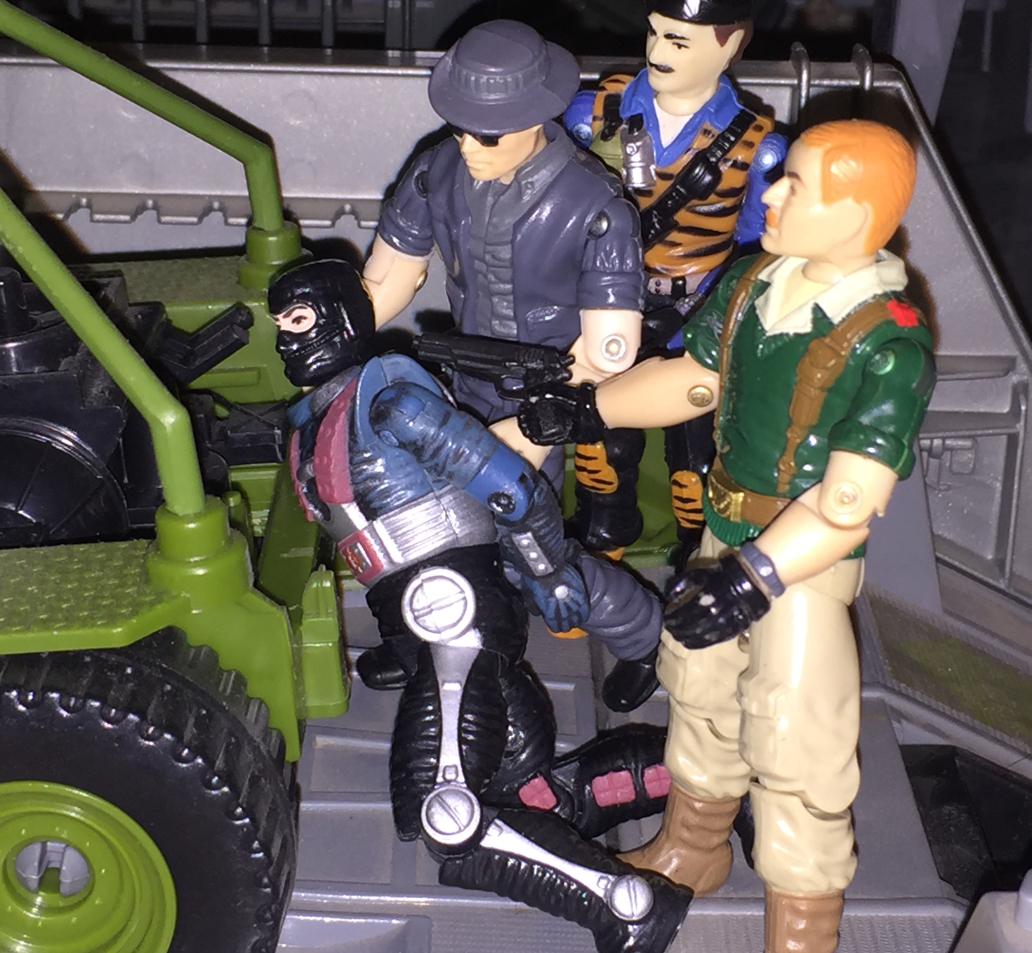
1984 VAMP Mark II, Clutch, Buzzer, Dreadnok, 1985


1984 VAMP Mark II, Clutch, Tiger Force Flint, 1988


1984 VAMP Mark II, Clutch, 1997 Stalker, Snake Eyes


1984 VAMP Mark II, 1992 Talking Battle Commander Stalker, 1990 Bullhorn